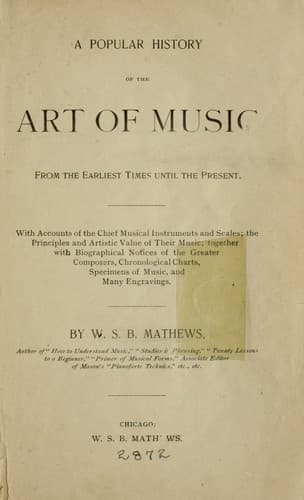
A Popular History of the Art of Music: From the Earliest Times Until the PresentMathews, W. S. B. (William Smythe Babcock)
History
A Popular History of the Art of Music: From the Earliest Times Until the Present
Mathews, W. S. B. (William Smythe Babcock)
Music -- History and criticism
"_Lohengrin_." When it was produced in Berlin in 1825, the enthusiasm
was yet greater and more remarkable than in Vienna. In 1825 he
composed "_Oberon_," the first of the operas in which the fairy
principle has prominent exemplification. This was produced in London
early in 1826. But by this time Weber's health had become completely
broken, and he died there of overwork and fatigue. He was laid to his
rest, to the music of Mozart's Requiem, in the chapel at Moorsfields
in London.
Weber was the first of the romantic composers--the first, at least, to
gain the ear of the public. These operas, with their beautifully
descriptive music, in which voices and orchestra co-operate with the
action and scene as one, were composed at the same time that the young
Franz Schubert was improvising his beautiful songs in Vienna. From one
end of Germany to the other, and in all Europe, these operas made
their way. "_Der Freischuetz_" has lasted fifty years, and is still
presented with success. More than that, as already noticed, Weber
furnished the model, or point of departure, for a multitude of smaller
composers, who developed the opera in various side directions; and
last, but not least, for Richard Wagner himself.
Moreover, in the department of piano playing Weber was no less
epoch-marking than in that of opera. In 1812 his sonata in C, Opus 24,
was produced, a work which is distinctly in advance of those of
Clementi or any other writer before that time. The finale of this work
is the well known rondo "Perpetual Motion," which, indeed, contains no
new principle of piano playing, but is an elegant example of
melodiousness and real musicianly qualities displayed at the highest
possible speed. His next sonata, Opus 39, in A flat (1816), is still
more remarkable. The piano playing here is of an extremely brilliant
and picturesque description. Here also, in the _Andante_ we have the
tricks which he afterward made so effective in the _Concertstueck_, of
the legato melody accompanied by chords _pizzicati_. Equally
significant in this way is the sonata in D minor, Opus 49, published
in the same year as the preceding. Here we have very strong contrast
and an enormous fire and vigor. The romantic impulse, however, had
been displayed yet earlier in his "_Momento Capriccioso_," Opus 12, in
B flat (1808). This extremely rapid piece of changing chords
_pianissimo_ is like a reminiscence from fairy land, and the second
subject contrasts with it to a degree which would have satisfied
Schumann. It is a choral-like movement with intervening interludes in
the bass, upon which Rubinstein must have modeled his "_Kamennoi
Ostrow_," No. 22. But the most decided token of the romantic movement
is seen in the "Invitation to the Dance," and the "_Polacca
Brilliant_," both of which were published in 1819. Two years later
came the concert piece, which for seventy years has remained a
standard selection for brilliant pianists, and for fifteen years was
Liszt's great concert solo.
Public-domain text, read in full here on John Shaqi.
Reviews
Reviews
No reviews yet
Be the first to share your thoughts on this work.
Elsewhere in the archive
Join the Discussion
Join the discussion
Sign in to leave a comment or review.
Sign InorCreate an account