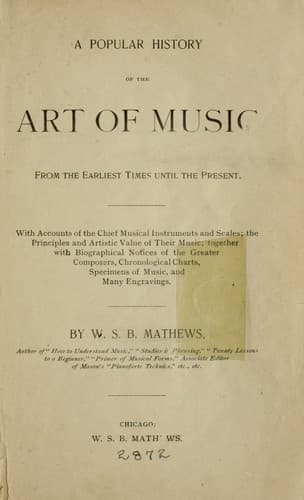
A Popular History of the Art of Music: From the Earliest Times Until the PresentMathews, W. S. B. (William Smythe Babcock)
History
A Popular History of the Art of Music: From the Earliest Times Until the Present
Mathews, W. S. B. (William Smythe Babcock)
Music -- History and criticism
It marks a transition from Moscheles,
Dussek and Clementi to Thalberg and Liszt. The "Invitation to the
Dance," moreover, was the first _salon_ piece idealized from a popular
dance form.
III.
Yet another distinguished name might well have been enrolled among
those of the great virtuosi of the first part of the nineteenth
century. Jacob Liebmann Beer, better known as Giacomo Meyerbeer
(1791-1864), was born at Berlin, the son of a rich Jewish banker. The
name Meyer was prefixed to his own later, as a condition of inheriting
certain property from a distant relative. As the boy showed talent
for music at a very early age, he was put to the study of the
pianoforte, and it was his ambition to distinguish himself as a
virtuoso, which his talent undoubtedly permitted, if he had not been
diverted from it by the success of his early attempts at opera. He was
taught by a pupil of Clementi, and for a while by Clementi himself, as
well as by other distinguished teachers, and if reports are to be
believed concerning his playing, he must have become by the time he
was twenty years old one of the very first virtuosi in Europe. His
studies in theory were carried on under Abbe Vogler, at Darmstadt,
where he was a schoolmate with C.M. von Weber and Gansbacher, and
later with Salieri at Vienna. At Darmstadt he wrote an oratorio "God
and Nature," which was performed by the _Singakademie_, of Berlin, in
1811; and an opera, "_Alimelek_" ("The Two Caliphs"), which also was
successfully given at Munich in the Grand Opera House in the same
year, 1811. Both works were anonymous. The opera made considerable
reputation, and was played in several other cities. Upon Salieri's
direction he went to Venice, where he arrived in 1815, to find
Rossini's star in the ascendant, and all Venice, and Italy as well,
wild over the bewitching melodies of "_Tancredi_." Meyerbeer, having
that vein of cleverness and adaptability so characteristic of his
race, immediately became a composer of Italian operas, and produced in
Venice, "_Romilda e Constanza_" (Padua, 1815), "_Semiramide
Riconosciuta_" (Turin, 1819), "_Emma di Resburgo_" (Venice, 1820), the
latter also making a certain amount of reputation in Germany as "_Emma
von Leicester_." Then followed "_Margherita d'Anjou_" (Milan, _La
Scala_, 1820), "_L'Esule di Granata_" (Milan, 1822) and "_Il Crociato
in Egitto"_ (Venice, 1824). All of these were Italian operas, with
melody in quite the Rossini vein, with the same attention as Rossini
to the light, the pleasing and the vocal, but with a certain added
element of German cleverness of harmony and thematic treatment.
[Illustration: Fig. 77.
GIACOMO MEYERBEER.]
Public-domain text, read in full here on John Shaqi.
Reviews
Reviews
No reviews yet
Be the first to share your thoughts on this work.
Elsewhere in the archive
Join the Discussion
Join the discussion
Sign in to leave a comment or review.
Sign InorCreate an account