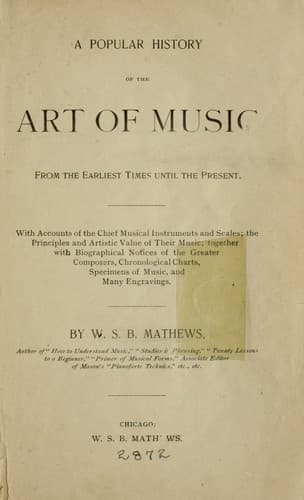
A Popular History of the Art of Music: From the Earliest Times Until the PresentMathews, W. S. B. (William Smythe Babcock)
History
A Popular History of the Art of Music: From the Earliest Times Until the Present
Mathews, W. S. B. (William Smythe Babcock)
Music -- History and criticism
He now returned to Berlin, but his opera, "_Das Brandenburger Thor_,"
which he had written for Berlin, was not performed, owing to opposing
intrigues. Nevertheless, for about six years Meyerbeer remained in his
native city, married, and presently lost two infant children. In 1830
he took up his abode in Paris, where already his "_Il Crociato_" had
been performed, in 1826, and in that city, as the leading composer for
grand opera, he lived six years, and finally died there. For the Paris
stage he produced a succession of large and sensational operas,
following to some extent the footsteps of Spontini, in respect to the
heroic, the spectacular and the theatrical. Up to the time of his
going to Paris, Meyerbeer had figured as an Italian composer in grace
of melody, German in his harmony, and now he became a French composer
in refinements of rhythm. His first work in Paris was "_Robert le
Diable_," 1831, and it made his reputation, and at the same time made
an epoch in operatic construction. It was followed by "_Les
Huguenots_," 1838, which when played in Berlin, in 1842, so pleased
the king, Friedrich Wilhelm IV, that he created Meyerbeer "General
Musical Director" for Prussia, and Meyerbeer came to Berlin to reside.
Here in 1842 he wrote his "_Das Feldlager in Schlesien_" in which
Jenny Lind made a great success. Later, however, he made over a great
part of this music for his opera of "_L'Etoile du Nord_," 1854, for
the Opera Comique in Paris. His remaining works were "_L'Africaine_,"
performed after his death, in 1865; "_Le Prophete_," 1843, and
"_Dinorah_," 1859. He died in Paris while superintending the
production of his "_L'Africaine_." In his will he left a fund of
10,000 thalers, the interest of which to be used as a prize for the
support of a young German composer during eighteen months' study in
Italy, Germany and France, six months in each. Besides the operas
above mentioned Meyerbeer wrote a quantity of other music for
orchestra, cantatas, and occasional pieces for festival purposes, of
which the "Schiller March" is an example.
Public-domain text, read in full here on John Shaqi.
Reviews
Reviews
No reviews yet
Be the first to share your thoughts on this work.
Elsewhere in the archive
Join the Discussion
Join the discussion
Sign in to leave a comment or review.
Sign InorCreate an account