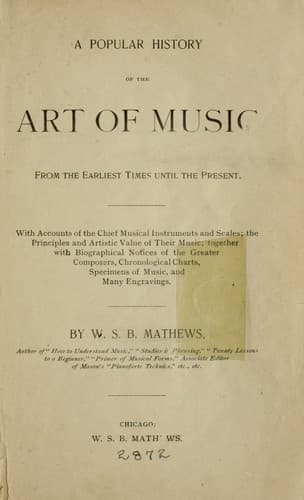
A Popular History of the Art of Music: From the Earliest Times Until the PresentMathews, W. S. B. (William Smythe Babcock)
History
A Popular History of the Art of Music: From the Earliest Times Until the Present
Mathews, W. S. B. (William Smythe Babcock)
Music -- History and criticism
The music of Meyerbeer is extremely sensational. His instrumentation
is rich, at times _bizarre_, and strongly contrasted. His knowledge of
stage effect, such that he knew by intuition what would do, and what
not. He was to some extent created by circumstances, a striking
instance of which is told in connection with the opera of the
"Huguenots," where the parting with Valentine at the end of the fourth
act was originally without important music. But the tenor declined to
take the part unless suitable music could be furnished him at this
point. Whereupon Meyerbeer wrote the impassioned duet, since so
celebrated, and which in fact is generally recognized as one of the
most suitable, not to say most effective, incidents of the whole
opera. Meyerbeer's operas follow the lead of Spontini in their
fondness for military glory and spectacle. They partake of the
virtuoso spirit of the other great geniuses mentioned in a later
chapter--all of whom wrote for the sake of an effect to be arrived at,
rather than from any inner necessity of carrying out their tone-poems
in such and such a way. Meyerbeer's influence, about 1830 to 1840, was
supreme upon the stage. It was to consult him that young Wagner
undertook his journey to Paris, bringing with him his splendid
spectacular opera "Rienzi," quite in the Meyerbeer vein. This feature
in the work, most likely, was the one chiefly concerned in preventing
its acceptance at Paris under Meyerbeer's direction. Wagner was very
much influenced by Meyerbeer in all his earlier works, particularly in
the matter of splendid appointments for the stage. With all the
splendid brilliancy of Meyerbeer's music, there is something insincere
about it. It rarely touches the deeper springs of feeling. This is
true of the greatest of his pieces, no less than of the smaller
numbers.
IV.
Public-domain text, read in full here on John Shaqi.
Reviews
Reviews
No reviews yet
Be the first to share your thoughts on this work.
Elsewhere in the archive
Join the Discussion
Join the discussion
Sign in to leave a comment or review.
Sign InorCreate an account