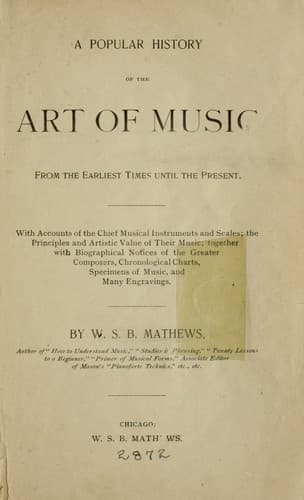
A Popular History of the Art of Music: From the Earliest Times Until the PresentMathews, W. S. B. (William Smythe Babcock)
History
A Popular History of the Art of Music: From the Earliest Times Until the Present
Mathews, W. S. B. (William Smythe Babcock)
Music -- History and criticism
The most interesting story in the history of opera, and one so
resplendent that it is impossible not to regard the others as merely
in some degree preparatory to it, is that of Richard Wagner
(1813-1883). This remarkable man was born in Leipsic in 1813, the son
of a superintendent of police. His mother was a woman of refined and
spiritual nature. After the death of his father, his mother married
again--an actor named Geyer--a circumstance having an important
bearing on the future of the composer. His brother Albert and his
sister Rosalie became actors, and Wagner himself was familiar with the
stage from earliest childhood. He studied music while a boy, but his
ambition was to become a poet. He translated the twelve books of the
Odyssey. He made the acquaintance of Shakespeare's plays, first in
German, afterward in English. He made a translation of Romeo's
soliloquy, and began to compose music for it. At the age of eighteen
he copied Beethoven's ninth symphony in score, for the purpose of
knowing it more thoroughly. His musical progress was such that at the
age of twenty-one he was able to accept a position as the conductor of
the opera at Magdeburg. In 1836 this failed, and he accepted a place
at Koenigsberg. He had then written one opera, called "The Love Veto."
In 1837 he was much interested in Bulwer's "Rienzi," and immediately
made a libretto from it. He was now musical director at Riga, and his
wife had leading feminine roles in opera. His favorite composer in
opera just then was Meyerbeer. For some reason he lost his place at
Riga, and resolved to visit London, taking ship across the Black sea.
It was a sailing vessel of small burden, and they encountered a very
violent storm. He heard the legend of the Flying Dutchman, and the
next year made a poem of it and commenced to write the opera. He spent
some time in Paris, where he hoped to get his "Rienzi" accepted at the
Grand Opera. This opera he had written on a large scale in the hope of
pleasing Meyerbeer, whose influence at Paris was very strong at this
time. This, however, he failed to do, very possibly because his opera
was too good. He was reduced to great straits, and had to write
_potpourri_ for the cornet and piano at a beggarly price, in order to
gain a living. In 1843 his "Rienzi" was accepted at Dresden, through
the influence of Meyerbeer. It was performed with great success, and
Wagner was called there as conductor. Here he had an important
position, having to produce the best operas of all schools. He brought
out his own "Flying Dutchman" and had already finished "_Tannhaeuser_."
He read the Arthur legends, and conceived the idea of an opera upon a
subject connected with the Holy Grail. This was "_Lohengrin_,"
completed in March, 1848. It was in a fair way to have been produced
under his own direction if he had had the good sense to let politics
alone; but in some way he mixed himself up in the revolutionary
attempt of that year, and was obliged to flee the country.
Public-domain text, read in full here on John Shaqi.
Reviews
Reviews
No reviews yet
Be the first to share your thoughts on this work.
Elsewhere in the archive
Join the Discussion
Join the discussion
Sign in to leave a comment or review.
Sign InorCreate an account