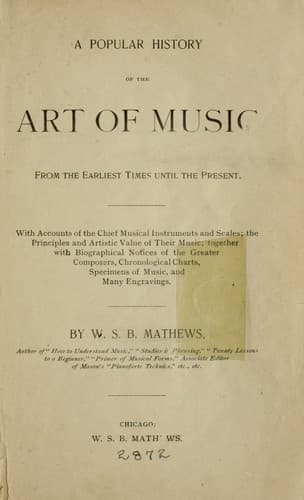
A Popular History of the Art of Music: From the Earliest Times Until the PresentMathews, W. S. B. (William Smythe Babcock)
History
A Popular History of the Art of Music: From the Earliest Times Until the Present
Mathews, W. S. B. (William Smythe Babcock)
Music -- History and criticism
suitable for church music, yet comedy in the best sense of the term.
The famous prize song in this work is sufficiently well known. There
is a most delightful finale in the third act, where Beckmesser's
serenade occurs as one of the incidents. The other work, "Tristan and
Isolde," is the most difficult opera that has ever been written, and
will have to wait a generation yet, most likely, before its beauties
are fully appreciated.
After composing these two enormous works, Wagner went on to finish
"_Siegfried_," and then completed the work by writing "_Die
Goetterdaemmerung_" ("The Twilight of the Gods"), or, "The Death of
Siegfried," as he had originally intended to call it. This work
contains one number which is stupendous in its pathos, "The Funeral
March of Siegfried." Nothing like it exists elsewhere. These four
operas have a very remarkable peculiarity, that throughout the four
there are certain leading motives, which repeatedly occur. There is
the motive of "the magic fire," which cuts a great figure in the first
opera of the series, where Loki, the fire god, appears and is ushered
in by this motive. It occurs again in the magic fire scene, at the
close of "_Die Walkuere_," where Wotan surrounds Brunhilde with
shrieking flames, in order that their terrors may deter cowards from
waking her. There is the "sword motive," which is heard in the first
opera, when this sword is first spoken of; it is finely developed
where the sword is drawn, and again in the opera of "_Siegfried_,"
where it is freshly welded. There is the "Walhalla motive," the
"Siegfried motive," the "Valkyrie motive," and many others, to the
number of nearly one hundred. These are woven together, especially in
the last opera of the series, in a most astonishing and wonderful way,
yet without impairing the musical flow of the work. The scores are
also extremely elaborate, from an orchestral point of view, requiring
a large number of instruments, most of them having a great deal to do.
This great trilogy, as Wagner called it, which was at first supposed
to be beyond the ability of the public to appreciate, has now been
given in all parts of Germany with great success, and it is no longer
beyond the ability of an audience to enjoy.
Public-domain text, read in full here on John Shaqi.
Reviews
Reviews
No reviews yet
Be the first to share your thoughts on this work.
Elsewhere in the archive
Join the Discussion
Join the discussion
Sign in to leave a comment or review.
Sign InorCreate an account