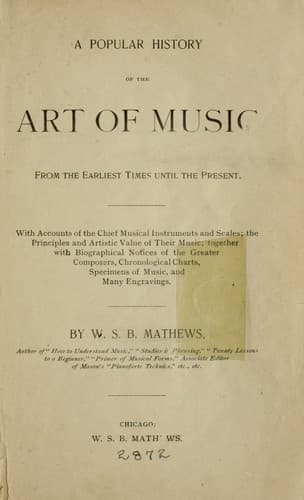
A Popular History of the Art of Music: From the Earliest Times Until the PresentMathews, W. S. B. (William Smythe Babcock)
History
A Popular History of the Art of Music: From the Earliest Times Until the Present
Mathews, W. S. B. (William Smythe Babcock)
Music -- History and criticism
He made a tour to the north of Italy, and heard the Italian musician
Paganini, which fired him with so much ardor, that he immediately set
himself to transcribe his Caprices for the piano, and to accomplish
upon this instrument similar effects to those which Paganini produced
upon the violin. At length, after much difficulty with his guardian
and his mother, it was agreed that he might fit himself for a
musician, so in 1830 he was back again in Leipsic studying diligently
with Master Wieck. In his ardor for great results in a short time, he
undertook some kind of mechanical discipline for the fourth finger of
his right hand, the effect of which was that the tendons became
overstrained, the finger crippled, and for a long time he was utterly
unable to use it in piano playing. In composition he now entered upon
regular instruction with Heinrich Dorn, at that time conductor of the
opera in Leipsic. Dorn recognized the greatness of Schumann's genius,
and devoted himself with much interest to his improvement. In 1832 a
symphony of his was produced in Zwickau, but apparently with little
success, for the work was never heard of afterward. At this same
concert Wieck's daughter, Clara, who was then thirteen years of age,
appeared as a pianist, and Zwickau, Schumann says, "was fired with
enthusiasm for the first time in its life." Already he was very much
interested in the promising girl, and expresses himself concerning her
with much ardor. He seems to have been singularly slow in composition.
At this time, 1833, he had written the first and third movements of
the G minor sonata, had commenced the F minor sonata and completed the
"Toccata," which had been begun four years before. He also arranged
the second set of Paganini's caprices, Opus 10. He found a faithful
friend in Frau Voigt, a pianist of sense and ability. Schumann usually
passed his evenings in a restaurant in company with his friends, after
the German fashion, but while the others talked he usually remained
silent. Frau Voigt told W. Taubert that one lovely summer evening
after making music with Schumann, they both felt inclined to go upon
the water. They sat side by side in the boat for an hour in silence.
At parting Schumann pressed her hand and said, "Good day, we have
perfectly understood one another."
Public-domain text, read in full here on John Shaqi.
Reviews
Reviews
No reviews yet
Be the first to share your thoughts on this work.
Elsewhere in the archive
Join the Discussion
Join the discussion
Sign in to leave a comment or review.
Sign InorCreate an account