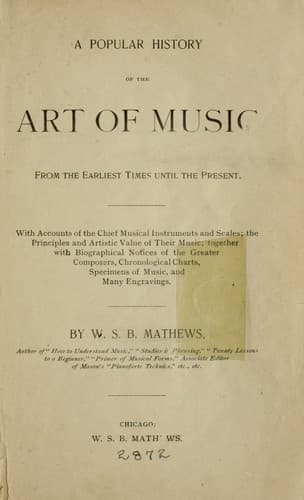
A Popular History of the Art of Music: From the Earliest Times Until the PresentMathews, W. S. B. (William Smythe Babcock)
History
A Popular History of the Art of Music: From the Earliest Times Until the Present
Mathews, W. S. B. (William Smythe Babcock)
Music -- History and criticism
The immediate result of the musical associations of Schumann, in
Leipsic, was the project for a musical journal, devoted to progress
and sincerity. In opera Rossini was then the ruling force. At the
piano Herz and Huenten; and musical journalism was represented by
_Allgemeine Musikalische Zeitung_, published by Breitkopf & Haertel,
which praised almost everything, upon general principles. In 1834,
the first number of the _Neue Zeitschrift fuer Musik_ saw the light.
The editors were Robert Schumann, Friedrich Wieck, Ludwig Schunke and
Julius Knorr. Schumann was the ruling power, and he proceeded to
develop his literary faculty in a variety of forms. He writes under
many pseudonyms, and has much to say about the "David league against
the Philistines," a society existing in his imagination only. One of
the famous early articles in this paper was that upon Chopin's
variation "_La ci Darem_," greeting the work of the talented young
Pole as a production of rare genius. Schumann himself thought so well
of this article that he placed it at the beginning of his collected
writings. It will be impossible within available limits to define the
influence of this journal. During the ten years when Schumann was
editor, many of the most important productions of the modern school
first saw the light, and all come in for discussion, from a point of
view at the same time sympathetic and intelligent.
As an example of the musical life at Leipsic in this time, Moscheles
mentions an evening in 1835, when Mendelssohn conducted his first
concert in the _Gewandhaus_; the day before this there had been a
musical gathering at Wieck's, at which both Mendelssohn and Schumann
were present, perhaps the first time that these two great geniuses
were brought together. The next day Mendelssohn, Schumann, Moscheles
and Banck dined together, and the next day there was music at Wieck's
house--Moscheles, Clara Wieck and L. Rakemann from Bremen, playing
Bach's D minor concerto for three pianos, Mendelssohn putting in the
orchestral accompaniments on the fourth piano. With Mendelssohn he
contracted quite an intimacy. In 1836 he found himself very much
devoted to Clara Wieck, and in order to secure a more favorable
opening for his career, resolved to transfer himself and the paper to
Vienna, but after a year he returned again to Leipsic, and then the
course of true love became more difficult, for Papa Wieck was
resolutely opposed to the match; but after some months his consent was
given, and they were married in 1840. During this year he had an
extraordinary activity as a song writer. The "Woman's Love and Life,"
the "Poet's Love," and various other cycles of song, were all produced
under the stress of his happy prospects with Clara. It is not easy to
ascertain the order of his compositions, since, as we have already
seen, the sonatas and some of the other works appearing late in the
list of opus numbers were composed very early.
Public-domain text, read in full here on John Shaqi.
Reviews
Reviews
No reviews yet
Be the first to share your thoughts on this work.
Elsewhere in the archive
Join the Discussion
Join the discussion
Sign in to leave a comment or review.
Sign InorCreate an account