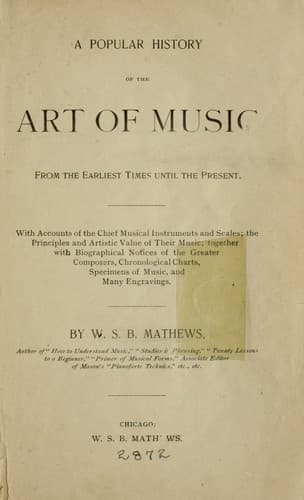
A Popular History of the Art of Music: From the Earliest Times Until the PresentMathews, W. S. B. (William Smythe Babcock)
History
A Popular History of the Art of Music: From the Earliest Times Until the Present
Mathews, W. S. B. (William Smythe Babcock)
Music -- History and criticism
The romantic tendency is the most marked of all of Schumann's
characteristics as a composer. He is above all others the composer of
moods. His long pieces are invariably aggregates of shorter ones. The
typical forms of Schumann's thought are two, and two only, the Song
and the Fantasia. He made diligent efforts to master counterpoint and
fugue, and manly attempts in these provinces can be found among his
writings; but counterpoint and fugue remained to him a foreign
language. The smoothness of Mendelssohn, the readiness of Bach, of
Beethoven, or even Mozart, are impossible to him. On the other hand,
when he follows his own inclination, he creates forms that are clear,
concise and original. One scarcely knows which to admire more--the
graphic correspondence of the music with the suggestive title placed
at the head, or the original style of the music itself, which is
entirely unlike anything by any former composer. His Opus 2 is a set
called _Papillons_, "Butterflies," or "Scenes at a Ball," consisting
of twelve short movements in different style, without explanatory
titles. Some are fantastic, others are sentimental, all original and
striking. The eleventh number of this is a short but magnificent
polonaise in D major, an extremely spirited and beautiful movement
which has since been very popular. The transcriptions of the Paganini
caprices were undertaken as studies for the composer himself in the
direction of unexplored pianoforte effects, but Schumann had also the
intention of providing in music new discipline for piano students. In
my opinion the technical value of these works has not yet been
realized, and it is quite possible that a later generation may esteem
them more highly than the present. However this may be, the practice
of writing gave Schumann a greater freedom, the effect of which is
seen upon the next set of pieces, the six _Intermezzi_. These,
however, are vague and mystical, rather than clear. With the "David's
League Dances" the Schumann nature appears more plainly. The style is
freer, and these new combinations are very charming, although they
must undoubtedly have been fatal stumbling blocks to the fingers of a
pianist trained in Dussek and Huenten. "The Carnival," a series of
fanciful scenes, belongs to an earlier period, having been composed in
1834 and 1835. The different numbers, of which there are twenty-one,
are provided with explanatory titles, such as "Pierrot," "Harlequin,"
"Valse Noble," "Eusebius," "Chopin," etc. Of all the earlier works the
Fantasy-Pieces, Opus 12, are the most successful. These eight
pictures, "In the Evening," "Soaring," "Why," "Whims," "In the Night,"
"Fable," "Dreams," and "The End of the Song," or peroration, are
extremely characteristic and beautiful, and it is not easy to assign
the pre-eminence of one number over the others. Of the same general
class, only upon a smaller scale, are the "Scenes from Childhood,"
Opus 15, of which there are thirteen little pieces, each with an
Public-domain text, read in full here on John Shaqi.
Reviews
Reviews
No reviews yet
Be the first to share your thoughts on this work.
Elsewhere in the archive
Join the Discussion
Join the discussion
Sign in to leave a comment or review.
Sign InorCreate an account