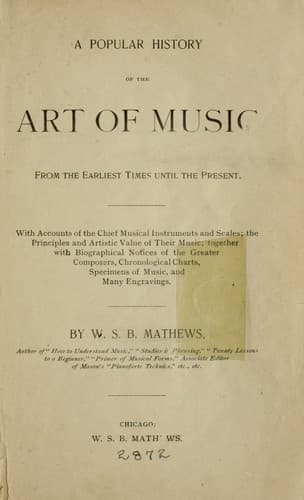
A Popular History of the Art of Music: From the Earliest Times Until the PresentMathews, W. S. B. (William Smythe Babcock)
History
A Popular History of the Art of Music: From the Earliest Times Until the Present
Mathews, W. S. B. (William Smythe Babcock)
Music -- History and criticism
explanatory title, such as "Playing Tag," "Happy Enough," "Dreams"
(_Traumerei_). In this direction Schumann often composed at a later
period of his life. There is the "Album for the Young," Opus 68,
containing forty-three short pieces, all with titles; the twenty
"Album Leaves," Opus 124, and the "Forest Scenes," with titles like
"The Entrance," "The Hunter on the Lookout," "Solitary Flowers,"
"Prophetic Bird," "Hunting Song," etc.
Schumann's greatness as a composer for the pianoforte, both from a
technical and poetic standpoint, is shown in such works as the
"_Etudes Symphoniques_," the "_Kreisleriana_," and the concerto in A
minor. The first of these works is regarded by many as the most
satisfactory of any of this author's works. It consists of an air,
nine variations and a finale which is in rondo form. The variations,
however, are fantasies rather than variations, the theme itself
appearing very little in any of them, and in some of them not at all.
It would be impossible to find within the same compass a similar
number of pages covering so wide a range of beautiful pianoforte
effects, and highly suggestive and poetic music. In the fantasia in C,
Schumann's fancy takes on a more serious mood. He treats the piano
with great freedom, requiring of the player a powerful touch and much
refinement of tone-color, as well as a style of technique which he
himself has largely created. The second movement of this, the march
tempo, represents Schumann's imagination in a forcible light in two
directions--its bold, strong moods, and its deeply subjective,
meditative activity. The "_Kreisleriana_" consists of eight fantasies
named after an old schoolmaster near Leipsic, noted for his
eccentricities. This work was coldly received when first produced, but
later has become very popular. The best movements are the first and
second, but the entire work is strong. The concerto in A minor is by
no means a show piece for the piano, but an extremely vigorous and
poetic improvisation, in which the solo and orchestral instruments
answer each other, and work together in a furor of inspiration.
Public-domain text, read in full here on John Shaqi.
Reviews
Reviews
No reviews yet
Be the first to share your thoughts on this work.
Elsewhere in the archive
Join the Discussion
Join the discussion
Sign in to leave a comment or review.
Sign InorCreate an account