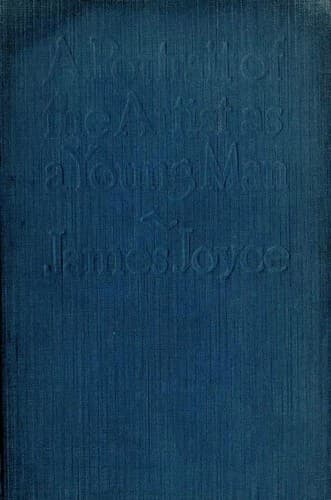
A Portrait of the Artist as a Young ManJoyce, James
General
A Portrait of the Artist as a Young Man
Joyce, James
Artists -- Fiction; Autobiographical fiction; Bildungsromans; Dublin (Ireland) -- Fiction; Young men -- Fiction
He was passing at that moment before the jesuit house in Gardiner
Street, and wondered vaguely which window would be his if he ever
joined the order. Then he wondered at the vagueness of his wonder, at
the remoteness of his own soul from what he had hitherto imagined her
sanctuary, at the frail hold which so many years of order and obedience
had of him when once a definite and irrevocable act of his threatened
to end for ever, in time and in eternity, his freedom. The voice of the
director urging upon him the proud claims of the church and the mystery
and power of the priestly office repeated itself idly in his memory.
His soul was not there to hear and greet it and he knew now that the
exhortation he had listened to had already fallen into an idle formal
tale. He would never swing the thurible before the tabernacle as
priest. His destiny was to be elusive of social or religious orders.
The wisdom of the priest’s appeal did not touch him to the quick. He
was destined to learn his own wisdom apart from others or to learn the
wisdom of others himself wandering among the snares of the world.
The snares of the world were its ways of sin. He would fall. He had not
yet fallen but he would fall silently, in an instant. Not to fall was
too hard, too hard; and he felt the silent lapse of his soul, as it
would be at some instant to come, falling, falling, but not yet fallen,
still unfallen, but about to fall.
He crossed the bridge over the stream of the Tolka and turned his eyes
coldly for an instant towards the faded blue shrine of the Blessed
Virgin which stood fowl-wise on a pole in the middle of a hamshaped
encampment of poor cottages. Then, bending to the left, he followed the
lane which led up to his house. The faint sour stink of rotted cabbages
came towards him from the kitchen gardens on the rising ground above
the river. He smiled to think that it was this disorder, the misrule
and confusion of his father’s house and the stagnation of vegetable
life, which was to win the day in his soul. Then a short laugh broke
from his lips as he thought of that solitary farmhand in the kitchen
gardens behind their house whom they had nicknamed the man with the
hat. A second laugh, taking rise from the first after a pause, broke
from him involuntarily as he thought of how the man with the hat
worked, considering in turn the four points of the sky and then
regretfully plunging his spade in the earth.
Public-domain text, read in full here on John Shaqi.
Reviews
Reviews
No reviews yet
Be the first to share your thoughts on this work.
Elsewhere in the archive
Join the Discussion
Join the discussion
Sign in to leave a comment or review.
Sign InorCreate an account