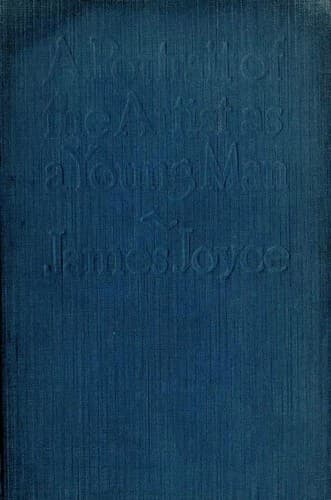
A Portrait of the Artist as a Young ManJoyce, James
General
A Portrait of the Artist as a Young Man
Joyce, James
Artists -- Fiction; Autobiographical fiction; Bildungsromans; Dublin (Ireland) -- Fiction; Young men -- Fiction
—I have a book at home, said Stephen, in which I have written down
questions which are more amusing than yours were. In finding the
answers to them I found the theory of esthetic which I am trying to
explain. Here are some questions I set myself: _Is a chair finely made
tragic or comic? Is the portrait of Mona Lisa good if I desire to see
it? Is the bust of Sir Philip Crampton lyrical, epical or dramatic. If
not, why not?_
—Why not, indeed? said Lynch, laughing.
—_If a man hacking in fury at a block of wood,_ Stephen continued,
_make there an image of a cow, is that image a work of art? If not, why
not?_
—That’s a lovely one, said Lynch, laughing again. That has the true
scholastic stink.
—Lessing, said Stephen, should not have taken a group of statues to
write of. The art, being inferior, does not present the forms I spoke
of distinguished clearly one from another. Even in literature, the
highest and most spiritual art, the forms are often confused. The
lyrical form is in fact the simplest verbal vesture of an instant of
emotion, a rhythmical cry such as ages ago cheered on the man who
pulled at the oar or dragged stones up a slope. He who utters it is
more conscious of the instant of emotion than of himself as feeling
emotion. The simplest epical form is seen emerging out of lyrical
literature when the artist prolongs and broods upon himself as the
centre of an epical event and this form progresses till the centre of
emotional gravity is equidistant from the artist himself and from
others. The narrative is no longer purely personal. The personality of
the artist passes into the narration itself, flowing round and round
the persons and the action like a vital sea. This progress you will see
easily in that old English ballad _Turpin Hero,_ which begins in the
first person and ends in the third person. The dramatic form is reached
when the vitality which has flowed and eddied round each person fills
every person with such vital force that he or she assumes a proper and
intangible esthetic life. The personality of the artist, at first a cry
or a cadence or a mood and then a fluid and lambent narrative, finally
refines itself out of existence, impersonalizes itself, so to speak.
The esthetic image in the dramatic form is life purified in and
reprojected from the human imagination. The mystery of esthetic, like
that of material creation, is accomplished. The artist, like the God of
creation, remains within or behind or beyond or above his handiwork,
invisible, refined out of existence, indifferent, paring his
fingernails.
—Trying to refine them also out of existence, said Lynch.
A fine rain began to fall from the high veiled sky and they turned into
the duke’s lawn to reach the national library before the shower came.
—What do you mean, Lynch asked surlily, by prating about beauty and the
imagination in this miserable Godforsaken island? No wonder the artist
retired within or behind his handiwork after having perpetrated this
country.
Public-domain text, read in full here on John Shaqi.
Reviews
Reviews
No reviews yet
Be the first to share your thoughts on this work.
Elsewhere in the archive
Join the Discussion
Join the discussion
Sign in to leave a comment or review.
Sign InorCreate an account