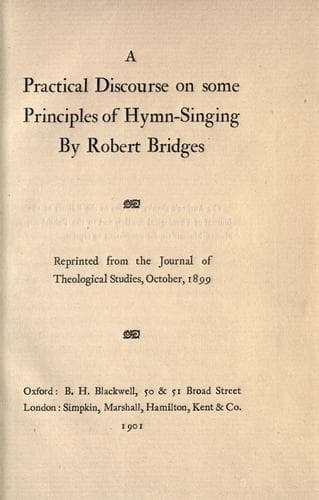
A Practical Discourse on Some Principles of Hymn-SingingBridges, Robert
Religion
A Practical Discourse on Some Principles of Hymn-Singing
Bridges, Robert
Church music -- Protestant churches; Hymns
Produced by Stephen Hutcheson (This file was produced from
images generously made available by The Internet
Archive/American Libraries.)
A
Practical Discourse on some
Principles of Hymn-Singing
By Robert Bridges
1901
_Price, One Shilling, net_
A
Practical Discourse on some
Principles of Hymn-Singing
By Robert Bridges
Reprinted from the Journal of
Theological Studies, October, 1899
Oxford: B. H. Blackwell, 50 & 51 Broad Street
London: Simpkin, Marshall, Hamilton, Kent & Co.
1901
The Author's thanks are due to the Editors of the Journal of Theological
Studies, and to the Publishers, Messrs. Macmillan, for permission to
reprint.
A
PRACTICAL DISCOURSE
ON SOME
PRINCIPLES OF HYMN-SINGING
What St. Augustin says of the emotion which he felt on hearing the music
in the Portian basilica at Milan in the year 386 has always seemed to me
a good illustration of the relativity of musical expression; I mean how
much more its ethical significance depends on the musical experience of
the hearer, than on any special accomplishment or intrinsic development
of the art. Knowing of what kind that music must have been and how few
resources of expression it can have had,--being rudimental in form,
without suggestion of harmony, and in its performance unskilful, its
probably nasal voice-production unmodified by any accompaniment,--one
marvels at his description,
'What tears I shed at Thy hymns and canticles, how acutely was my soul
stirred by the voices and sweet music of Thy Church! As those voices
entered my ears, truth distilled in my heart, and thence divine
affection welled up in a flood, in tears o'erflowing, and happy was I
in those tears[1].'
St. Augustin appears to have witnessed the beginnings of the great music
of the Western Church. It was the year of his baptism when, he tells us,
singing was introduced at Milan to cheer the Catholics who had shut
themselves up in the basilica with their bishop, to defend him from the
imperial violence:
'It was then instituted that psalms and hymns should be sung, after the
manner of the Eastern Churches, lest the folk in the weariness of their
grief should altogether lose heart: and from that day to this the
custom has been retained; many, nay, nearly all Thy flocks, in all
regions of the world, following the example[2].'
What great emotional power St. Augustin attributed to ecclesiastical
music, and of what importance he thought it, may be seen in the tenth
book of the _Confessions_: he is there examining himself under the heads
of the senses, and after the sense of smell, his chapter on the sense of
hearing is as follows:
Public-domain text, read in full here on John Shaqi.
Reviews
Reviews
No reviews yet
Be the first to share your thoughts on this work.
Join the Discussion
Join the discussion
Sign in to leave a comment or review.
Sign InorCreate an account