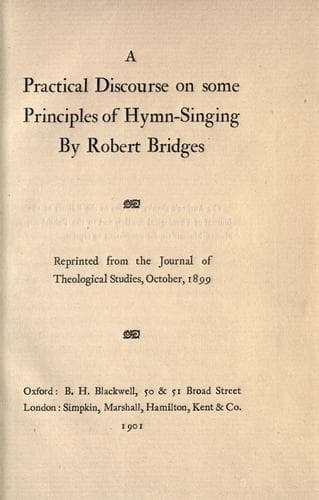
A Practical Discourse on Some Principles of Hymn-SingingBridges, Robert
Religion
A Practical Discourse on Some Principles of Hymn-Singing
Bridges, Robert
Church music -- Protestant churches; Hymns
'The lust of the ears entangled and enslaved me more firmly, but Thou
hast loosened and set me free. But even now I confess that I do yield a
very little to the beauty of those sounds which are animated by Thy
eloquence, when sung with a sweet and practised voice; not, indeed, so
far that I am limed and cannot fly off at pleasure[3]: and yield though
I do, yet these sweet sounds, joined with the divine words which are
their life, cannot be admitted to my heart save to a place of some
dignity, and I hesitate to give them one as lofty as their claim[4].
'For sometimes I seem to myself to be allowing them undue honour, when
I feel that our minds are really moved to a warmer devotion and more
ardent piety by the holy words themselves when they are so sung than
when they are not so sung; and when I recognize that all the various
moods of our spirit have their proper tones in speech and song, by
which they are, through I know not what secret familiarity, excited.
But the mere sensuous delight, to which it is not fitting to resign the
mind to be enervated thereby, often deceives me, whenever (that is) the
delight of the senses does not so accompany the reason as to be
cheerfully in submission thereto, but, having been admitted only for
reason's sake, then even attempts to go before and to lead. Thus I sin
without knowing, but afterwards I know.
'Then awhile, from too immoderate caution against this deception, I err
on the side of too great severity; and sometimes go so far as to wish
that all the melody of the sweet chants which are used in the Davidian
psalter were utterly banished from my ears, and from the ears of the
Church; and that way seems to me safer which I remember often to have
heard told of Athanasius, archbishop of Alexandria, that he would have
the lector of the psalm intone it with but a slight modulation of
voice, so as to be more like one reading than one singing. And yet,
when I remember my tears, which I shed at the hearing of the song of
Thy Church in the first days of my recovered faith, and that now I
still feel the same emotion, and am moved not by the singing but by
what is sung, when it is sung with a liquid voice and in the most
fitting "modulation," then (I say) I acknowledge again the great
utility of the institution.
'Thus I fluctuate between the peril of sensuous pleasure and the proof
of wholesomeness, and am more inclined (though I would not offer an
irrevocable judgement) to approve of the use of singing in the Church,
that, by the pleasure of the ear, weaker minds may rise to the emotion
of piety. Yet when it happens to me to be more moved by the music than
by the words that are sung I confess that I have sinned (poenaliter
peccare), and it is then that I would rather not hear the singer[5].'
Public-domain text, read in full here on John Shaqi.
Reviews
Reviews
No reviews yet
Be the first to share your thoughts on this work.
Join the Discussion
Join the discussion
Sign in to leave a comment or review.
Sign InorCreate an account