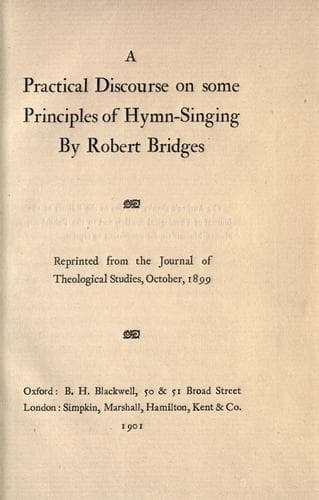
A Practical Discourse on Some Principles of Hymn-SingingBridges, Robert
Religion
A Practical Discourse on Some Principles of Hymn-Singing
Bridges, Robert
Church music -- Protestant churches; Hymns
Both these ideas are absolutely wrong. A hymn-tune, which they hastily
assume to be the commonest and lowest form of music, actually possesses
liberties coveted by other music[13]. It is a short melody, committed to
memory, and frequently repeated: there is no reason why it should submit
to any of the time-conveniences of orchestral music: there is no reason
why its rhythm should not be completely free; nor is there any _a priori_
necessity why any one tune should be exactly like another in rhythm. It
will be learned by the ear (most often in childhood), be known and loved
for its own sake, and blended in the heart with the words which interpret
it: and this advantage was instinctively felt by those of our early
church composers who, already understanding something of the value of
barred music, yet deliberately avoided cramping the rhythms of their
hymn-tunes by too great subservience to it[14]. One of the first duties
therefore which we owe to hymn-melodies is the restoration of their free
and original rhythms, keeping them as varied as possible: the Plain-song
melodies must be left unbarred and be taught as free rhythms, and all
other fine tunes which are worth using should be preserved in their
original rhythm; because free rhythm is better, and its variety is good,
and because the attraction of a hymn-melody lies in its individual
character and expression, and not at all in its time-likeness to other
tunes. This last idea has been a chief cause in the degradation of our
hymns.
I may conclude then that the best of these simpler Plain-song tunes are
very fit for congregational use. They should be offered as pure melody in
free rhythm and sung in unison: their accompaniment must not be entrusted
to a modern grammarian. It is well also to use most of them in their
English form, the _Old Sarum Use_ as it is called; which happily
preserves to us a national tradition, in the opinion of some experts
older and more correct than any known on the continent; and if the
differences in our English version are not due to purity of tradition,
they will have another and almost greater interest, as venerable records
of the genius of our national taste. These Plain-song tunes have probably
a long future before them; since, apart from their merit, they are
indissolubly associated with the most ancient Latin hymns, some of which
are the very best hymns of the Church.
Public-domain text, read in full here on John Shaqi.
Reviews
Reviews
No reviews yet
Be the first to share your thoughts on this work.
Join the Discussion
Join the discussion
Sign in to leave a comment or review.
Sign InorCreate an account