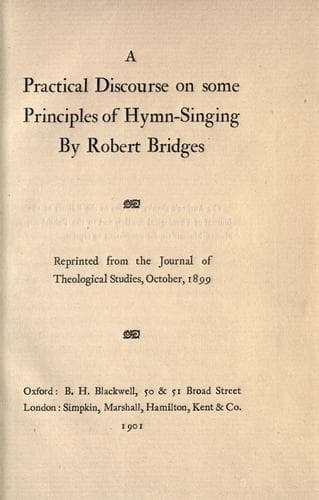
A Practical Discourse on Some Principles of Hymn-SingingBridges, Robert
Religion
A Practical Discourse on Some Principles of Hymn-Singing
Bridges, Robert
Church music -- Protestant churches; Hymns
The next class of tunes[15] is that of the Reformation hymns, English,
French, and German, dating from about 1550 to some way on in the
seventeenth century. The chief English group is known as _Sternhold and
Hopkins' Psalter_, which was mostly of eight-line tunes. This book was
virtually put together in Geneva about 1560, and antiquarians make much
of it. If stripped, however, of its stolen plumes and later additions it
is really an almost worthless affair, the true history of it being as
follows. A French musician named Louis Bourgeois, whom Calvin brought
with him to Geneva in 1541, turned out to be an extraordinary genius in
melody; he remained at Geneva about fifteen years, and in that time
compiled a Psalter of eighty-five tunes, almost all of which are of great
merit, and many of the very highest excellence. The splendour of his
work, which was merely appreciated as useful at the time, was soon
obscured, for immediately on his leaving Geneva, the French Psalter was
completed by inferior hands, whose work, being mixed in with his, lowered
the average of the whole book enormously, and Bourgeois' work was never
distinguished until, quite lately, the period of his office was
investigated and compared with the succeeding editions of his book. Now
the English refugees compiled their 'Sternhold and Hopkins' at Geneva, in
imitation of the French, during the time of Bourgeois' residence, and
took over a number of the French tunes; though they _mauled these most
unmercifully_ to bring them down to the measure of their doggerel psalms,
yet even after this barbarous treatment Bourgeois' spoilt tunes were
still far better than what they made for themselves, and sufficient not
only to float their book into credit, but to kindle the confused
enthusiasm of subsequent English antiquarians, whose blind leadership has
had some half-hearted following. But if these French tunes, and those
which are pieced in imitation of Bourgeois, be extracted from this
English Psalter, then, with one or two exceptions, there will remain
hardly anything of value[16].
To leave the English tunes for a moment and continue the subject, we
shall practically exhaust the French branch of this class by saying that
our duty by them is to use a great number of Bourgeois' tunes, _restoring
their original form_. They are masterpieces which have remained popular
on the continent from the first; thoroughly congenial to our national
taste, and the best that can be imagined for solemn congregational
singing of the kind which we might expect in England. The difficulty is
the same that beset the old original psalter-makers, i.e. to find words
to suit their varied measures. But this must be done[17]. These tunes in
dignity, solemnity, pathos, and melodic solidity leave nothing to desire.
Public-domain text, read in full here on John Shaqi.
Reviews
Reviews
No reviews yet
Be the first to share your thoughts on this work.
Join the Discussion
Join the discussion
Sign in to leave a comment or review.
Sign InorCreate an account