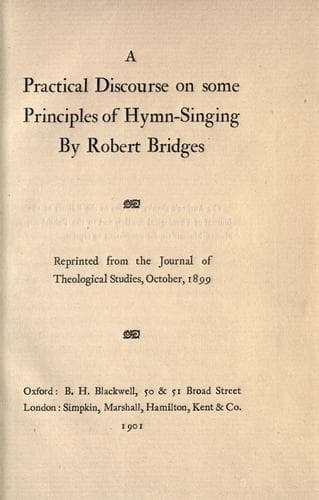
A Practical Discourse on Some Principles of Hymn-SingingBridges, Robert
Religion
A Practical Discourse on Some Principles of Hymn-Singing
Bridges, Robert
Church music -- Protestant churches; Hymns
It is necessary to insist strongly on one caution, viz. that grammar is
not style, and settings which avoid modernisms are not for that reason a
fair presentation of the old manner. Nothing is less like a fine work of
art than its incompetent imitation. And this practically exhausts, as far
as I am aware, the material which this period provides.
The next class will be made up of our Restoration hymns, by Jeremy Clark,
Croft, and others who added to the succeeding editions of the metrical
Psalms. If there are not many in this class, yet the few are good; and
Clark must be regarded as the inventor of the modern English hymn-tune,
regarded, that is, as a pure melody in the scale with harmonic
interpretation of instrumental rather than true vocal suggestion. His
tunes are pathetic, melodious, and of truly national and popular
character, the best of them almost unaccountably free from the
indefinable secular taint that such qualities are apt to introduce, and
which the bad following of his example did very quickly introduce in the
hands of less sensitive artists. They are suitable for evening services.
After this time there followed in England, in the wake of Handel, a
degradation of style which is now completely discredited. Diatonic flow,
with tediously orthodox modulation, overburdened with conventional
graces, describe these innumerable and indistinguishable productions. And
just as the old tunes were related to the motets and madrigals, so are
these to the verse-anthems and glees of their time. These weak ditties,
in the admired manner of Lord Mornington, were typically performed by the
genteel pupils of the local musician, who, gathered round him beneath the
laughing cherubs of the organ case, warbled by abundant candlelight to
their respectful audience with a graceful execution that rivalled the
weekday performances of _Celia's Arbour_ and the _Spotted Snakes_. Good
tunes may be written at any time, for style is independent of fashion;
but there are very few exceptions to the complete and unregretted
disappearance of all the tunes of this date.
We have then nothing left for us to do but to review the material which
the revival of music in the last fifty years has given us in the way of
hymns.
This last group divides naturally into two main heads; first the
restoration of old hymns of all kinds, with their plain, severer manner,
in reaction against the abused graces; and secondly the appearance of a
vast quantity of new hymns.
Concerning the restoration of the old hymns, we cannot be too grateful to
those who pointed the right way, and, according to their knowledge and
the opportunities of the taste of their day, did the best that they
could. But, as our remarks under the heads of Plain-song and Reformation
hymns will show, this knowledge, taste, and opportunity were
insufficient, and all their work requires to be done afresh.
Public-domain text, read in full here on John Shaqi.
Reviews
Reviews
No reviews yet
Be the first to share your thoughts on this work.
Join the Discussion
Join the discussion
Sign in to leave a comment or review.
Sign InorCreate an account