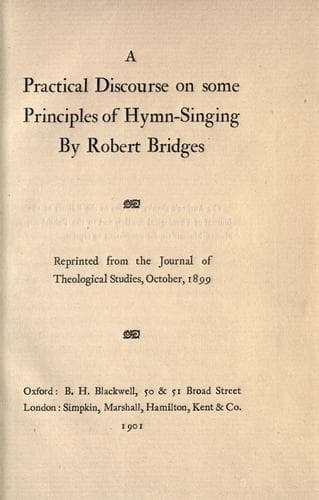
A Practical Discourse on Some Principles of Hymn-SingingBridges, Robert
Religion
A Practical Discourse on Some Principles of Hymn-Singing
Bridges, Robert
Church music -- Protestant churches; Hymns
We are therefore left to the examination of the modern hymns. In place of
this somewhat invidious task, I propose to make a few remarks on the
general question of the introduction of modern harmony into
ecclesiastical music, with reference of course to hymns only. It cannot
escape the attention of any one that the modern church music has for one
chief differentiation the profuse employment of pathetic chords, the
effect of which is often disastrous to the feelings.
Comparing a modern hymn-tune in this style with some fine setting of an
old tune in the diatonic ecclesiastical manner, one might attribute the
superiority of the old music entirely to its harmonic system; but I think
this would be wrong.
It is a characteristic of all early art to be _impersonal_[19]. As long
as an art is growing, artists are engaged in rivalry to develop the new
inventions in a scientific manner, and individual personality is not
called out. With the exhaustion of the means in the attainment of
perfection a new stage is reached, in which individual expression is
prominent, and seems to take the place of the scientific impersonal
interest which aimed at nothing but beauty: so that the chief distinction
between early and late art is that the former is impersonal, the latter
personal.
Turning now to the subject of ecclesiastical music, and comparing thus
Palestrina with Beethoven or Mozart, is it not at once apparent that
Palestrina has this distinct advantage, namely, that he seems not to
interfere at all with, or add anything to, the sacred words? His early
musical art is impersonal, what the musicians call 'pure music'; and if
he is setting the phrases of the Liturgy or Holy Scriptures, we are not
aware of any adjunct; it seems rather as if the sacred words had suddenly
become musical. Not so with Mozart or Beethoven; we may prefer their
music, but it has interfered with the sacred words, it has, in fact,
added a personality.
It must of course be conceded that this gives a very strong if not
logically an almost unassailable position to those who would confine
sacred music to the ecclesiastical style. But it seems to me ridiculous
to suppose that genius cannot use all good means with reserve and
dignity; and if the modern church music will not stand comparison in
respect of dignity and solemnity with the old, the fault must rather lie
in the manner in which the new means are used, than in the means
themselves; nor would I myself concede that there is no place in church
for music which is tinged with a human personality; I should be rather
inclined to reckon the great musicians among the prophets, and to
sympathize with any one who might prefer the personality of Beethoven (as
revealed in his works) to that of a good many canonized seers. What is
logical is that we should be careful as to what personality we admit, and
see that the modern means are used with reserve.
Public-domain text, read in full here on John Shaqi.
Reviews
Reviews
No reviews yet
Be the first to share your thoughts on this work.
Join the Discussion
Join the discussion
Sign in to leave a comment or review.
Sign InorCreate an account