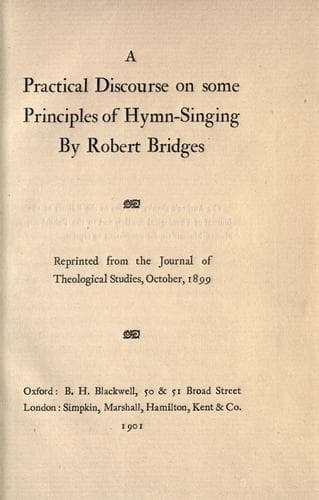
A Practical Discourse on Some Principles of Hymn-SingingBridges, Robert
Religion
A Practical Discourse on Some Principles of Hymn-Singing
Bridges, Robert
Church music -- Protestant churches; Hymns
What would St. Augustin have said could he have heard Mozart's Requiem,
or been present at some Roman Catholic cathedral where an
eighteenth-century mass was performed, a woman hired from the Opera-House
whooping the _Benedictus_ from the western gallery?
It is possible that such music would not have had any ethical
significance to him, bad or good. Augustin lived before what we reckon
the very beginnings of modern music, with nothing to entice and delight
his ears in the choir but the simplest ecclesiastical chant and hymn-tune
sung in unison. We are accustomed to an almost over-elaborated art,
which, having won powers of expression in all directions, has so
squandered them that they are of little value: and we may confidently say
that the emotional power of our church music is not so great as that
described by him 1,500 years ago. In fact if we feel at all out of
sympathy with Augustin's words, it is because he seems to over-estimate
the danger of the emotion[6].
There is something very strange and surprising in this state of things,
this contrast between the primitive Church with its few simple melodies
that ravished the educated hearer, and our own full-blown institution
with its hymn-book of some 600 tunes, which when it is opened fills the
sensitive worshipper with dismay, so that there are persons who would
rather not go inside a church than subject themselves to the trial.
What is the matter? What is it that is wrong with our hymnody? Even where
there is not such rooted disgust as I have implied, there is a growing
conviction that some reform is needed in words or music, or both.
Assuming that the chief blame lies with the music (as, I think, might
easily be proved), I propose to discuss the question of the music of our
hymnody, and I shall proceed on the basis of St. Augustin's principles: I
am sure that they would be endorsed by any pious church-goer who had
considered the subject, and they may be fairly formulated thus, _The
music must express the words or sense: it should not attract too much
attention to itself: it should be dignified: and its reason and use is to
heighten religious emotion._
One point calls for distinction: Augustin speaks of his emotion on
_hearing_ the hymns and canticles; he writes as if he had had no more
thought of taking part in the music himself, than we have of joining in
the anthem at a cathedral; and this might lead to a misunderstanding; for
there is no doubt that these hymns were sung by the people: the story is
that the very soldiers who were sent to blockade the basilica, happening
to be themselves catholics, joined their voices in the stanzas which St.
Ambrose had specially composed to disconcert the Arian enemy.
Public-domain text, read in full here on John Shaqi.
Reviews
Reviews
No reviews yet
Be the first to share your thoughts on this work.
Join the Discussion
Join the discussion
Sign in to leave a comment or review.
Sign InorCreate an account