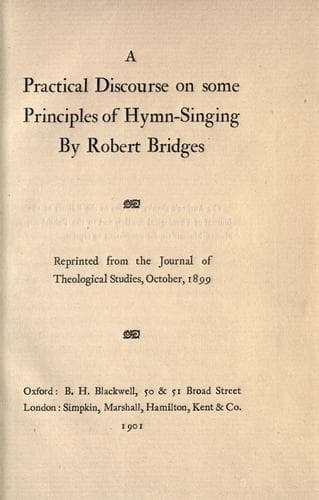
A Practical Discourse on Some Principles of Hymn-SingingBridges, Robert
Religion
A Practical Discourse on Some Principles of Hymn-Singing
Bridges, Robert
Church music -- Protestant churches; Hymns
All these last-named emotions,--which I have taken from congregational
hymn-books,--and I suppose there may be more of them,--call for delicacy
of treatment. A Lamentation, for instance, which might seem at first
sight as if it would gain force by volume, will, if it is realistic or
clumsy, become unmanly, almost so as to be ridiculous, and certainly
depressing to the spirit rather than purifying. In fact while many of the
subjects require beautiful expression, they are also more properly used
when offered as inspiring ideals; and to assume them to be of common
attainment or experience is to degrade them from their supreme sanctity.
But in thus ruling them unfit for general singing one must distinguish
large miscellaneous congregations from small united bodies, in which a
more intimate emotion may be natural: and as there is no exact line of
distinction here, so there is no objection to the occasional and partial
intrusion of some of these more intimate subjects into congregational
hymns.
To this first question then, as to what emotions are fit to be expressed
by congregational music, the answer appears to be that the more general
the singing, the more general and simple should be the emotion and that
the universally fitting themes are those of simple praise, prayer, or
faith: and we might inquire whether one fault of our modern hymn-books
may not be their attempt to supply congregational music to unfitting
themes.
To the next question, _Whose emotion_ is this congregational music to
excite or heighten? the answer is plain: It is the average man, or one
rather below the average, the uneducated, as St. Augustin says the
weaker, mind and that in England is, at least artistically, a narrow mind
and a vulgar being. And it may of course be alleged that the music in our
hymn-books which is intolerable to the more sensitive minds was not put
there for them, but would justify itself in its supposed fitness for the
lower classes. 'What use,' the pastor would say to one who, on the ground
of tradition advocated the employment of the old plain-song and the
Ambrosian melodies, 'What use to seek to attract such people as those in
my cure with the ancient outlandish and stiff melodies that pleased folk
a thousand years ago, and which I cannot pretend to like myself?' Or if
his friend is a modern musician, who is urging him to have nothing in his
church but what would satisfy the highest artistic sense of the day, his
answer is the same: he will tell you that it would be casting pearls
before swine; and that unless the music is 'tuney' and 'catchy' the
people will not take to it. And we cannot hastily dismiss these practical
objections. The very Ambrosian music which is now so strange to modern
ears was doubtless, when St. Ambrose introduced it, much akin to the
secular music of the day, if it was not directly borrowed from it: and
the history of hymn-music is a history of the adaptations of profane
successes in the art to the uses of the Church.
Public-domain text, read in full here on John Shaqi.
Reviews
Reviews
No reviews yet
Be the first to share your thoughts on this work.
Join the Discussion
Join the discussion
Sign in to leave a comment or review.
Sign InorCreate an account