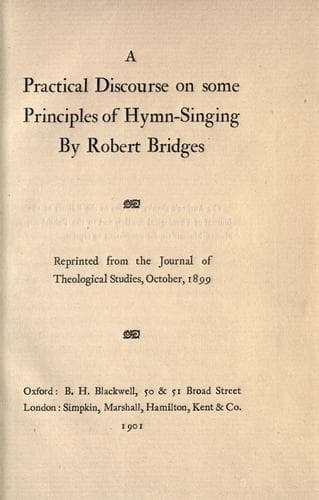
A Practical Discourse on Some Principles of Hymn-SingingBridges, Robert
Religion
A Practical Discourse on Some Principles of Hymn-Singing
Bridges, Robert
Church music -- Protestant churches; Hymns
Nor do I see that it can
ever be otherwise, for the highest music demands a supernatural material;
so that it would seem an equal folly for musicians to neglect the unique
opportunity which religion offers them, and for religion to refuse the
best productions of human art. And we must also remember that the art of
the time, whether it be bad or good, has a much more living relation to
the generation which is producing it, and exerts a more powerful
influence upon it, than the art of any time that is past and gone. It is
the same in all aspects of life: it is the book of the day, the hero or
statesman of the hour, the newest hope, the latest flash of scientific
light, which attracts the people. And it must be, on the face of it, true
that any artist who becomes widely popular must have hit off, 'I know not
by what secret familiarity,' the exact fashion or caprice of the current
taste of his own generation.
And this is so true that it must be admitted that it is not always the
uneducated man only whose taste is hit off. In the obituary notices of
such men as Gladstone and Tennyson the gossip will inform us, rightly or
wrongly, that their 'favourite hymn[7]' was, not one of the great
masterpieces of the world,--which, alas, it is only too likely that in
their long lives they never heard,--but some tune of the day: as if in
the minds of men whose lives appealed strongly to their age there must be
something delicately responsive to the exact ripple of the common taste
and fashion of their generation.
All this makes a strong case: and it would seem, since our hymn-music is
to stir the emotions of the vulgar, that it must itself be both vulgar
and modern; and that, in the interest of the weaker mind, we must
renounce all ancient tradition and the maxims of art, in order to be in
touch with the music-halls.
This is impossibly absurd; and unless there is some flaw in our argument,
the fault must lie in the premisses; we have omitted some necessary
qualification.
The qualification which we neglected is this, that _the music must be
dignified_, and suitable to the meaning; and we should only have wasted
words in ignoring what we knew all along, if we had not, by so doing,
brought this qualification into its vital prominence, and at the same
time exposed the position of those who neglect it, and the real reason of
the mean condition of our church music.
Public-domain text, read in full here on John Shaqi.
Reviews
Reviews
No reviews yet
Be the first to share your thoughts on this work.
Join the Discussion
Join the discussion
Sign in to leave a comment or review.
Sign InorCreate an account