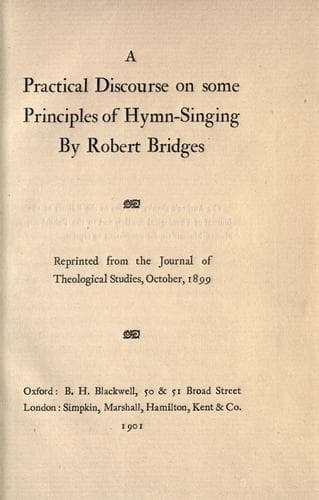
A Practical Discourse on Some Principles of Hymn-SingingBridges, Robert
Religion
A Practical Discourse on Some Principles of Hymn-Singing
Bridges, Robert
Church music -- Protestant churches; Hymns
The use of undignified music for sacred purposes may perhaps be justified
in exceptional cases, which must be left to the judgement of those who
consider all things lawful that they may save some. But if from the
mission service this licence should creep into the special service, and
then invade every act of public worship, it must be met with an edict of
unscrupulous exclusion. Not that it can be truly described as thus having
crept in in our time. It is always creeping, it has flourished in special
habitats for four or five hundred years, and before then there is the
history of Palestrina's great reform of like abuses. If in our time in
England we differ in any respect for the worse, it is rather in the
universal prevalence of a mild form of the degradation, which is perhaps
more degrading than the occasional exceptional abuses of a more flagrant
kind, which cannot hide their scandal but bring their own condemnation.
There is indeed no extreme from which this abuse has shrunk; perhaps the
worst form of it is the setting of sacred hymns to popular airs, which
are associated in the minds of the singers with secular, or even comic
and amatory words[8]: of which it is impossible to give examples, because
the extreme instances are blasphemies unfit to be quoted; and it is only
these which could convey an adequate idea of the licence[9] The essence
of the practice appears to be the production of a familiar excitement,
with the intention of diverting it into a religious channel.
But, even in the absence of secular or profane association,
congregational singing, when provoked by undignified music, such as may
be found in plenty in our modern hymn-books, may be maintained without
the presence of religious feeling, out of mere high spirits, or as we
say, 'in fun,' and may easily give rise to mockery. I have witnessed
examples enough in proof of this, but if I gave them it might be thought
that I wished to amuse profane readers[10]. And though such extreme
disasters may be exceptional outbursts, yet they are always but just
beneath the surface, and are the inevitable outcome of the use of
unworthy means. The cause of such a choice of means must be either an
artistic incapacity to distinguish, or a want of faith in the power of
religious emotion when unaided by profane adjuncts. What would St.
Augustin have ruled here, or thought of the confusion of ideas, which,
being satisfied with any expression, mistakes one emotion for another?
Public-domain text, read in full here on John Shaqi.
Reviews
Reviews
No reviews yet
Be the first to share your thoughts on this work.
Join the Discussion
Join the discussion
Sign in to leave a comment or review.
Sign InorCreate an account