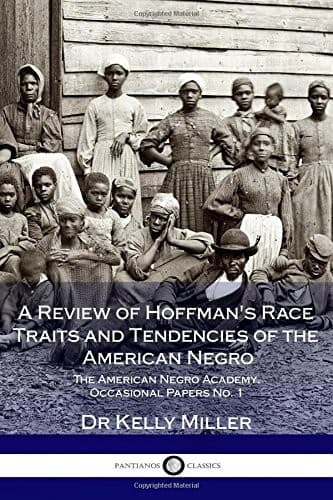
A Review of Hoffman's Race Traits and Tendencies of the American Negro: The American Negro Academy. Occasional Papers No. 1Miller, Kelly
Philosophy
A Review of Hoffman's Race Traits and Tendencies of the American Negro: The American Negro Academy. Occasional Papers No. 1
Miller, Kelly
African Americans; Hoffman, Frederick L. (Frederick Ludwig), 1865-1946. Race traits and tendencies of the American Negro
"And is not the law the same for all, and does it make any distinction
between rich and poor, white and black? Literally, the law is the same
for all. Then what more can be desired? The trouble is not that the laws
are partial, through some of its enactments, namely, the whipping-post,
chain-gang, and poll-tax laws, were aimed principally against the Negro;
but the trouble is with the interpretation of the laws by the juries,
who merely voice the public sentiment, which is superior to the law
itself. The average jury is a whimsical creature, subject to all kinds
of influences, though mostly of a sentimental character. In criminal
matters where whites are concerned, it seems ever to lean to the
defense; and the strongest arguments of the prosecution are easily
offset and upset by appeals on behalf of youth, family, station,
respectability, etc.; or, perhaps the whole family, weeping, is placed
in full view of the jury, and the susceptible jury, sure at least in
such cases to weep with them that weep, speedily brings in a verdict of
acquittal where guilt is clearly manifest; or it says jail where it
ought to say penitentiary; or one year where it ought to say ten; and
ten years where it ought to pronounce death. But the Negro has none of
these sentimental advantages. Too poor to employ competent counsel, his
liberty and life are necessarily committed to incompetent hands, when
the proverb of 'poor pay, poor preach' becomes reality ... But are
Negroes treated unfairly by juries and public opinion? Yes, and the
experience and observation of every fair-minded man will confirm the
assertion. One cardinal proof is that a white man seldom receives
punishment for assault, however brutal, however unprovoked, however
cowardly, be it maiming, homicide, or murder upon a Negro unless,
forsooth, the assailant be some degraded creature, disowned by his own
caste. Of the numberless instances--running into the thousands--during
the past twenty-three years, of homicide and murder of blacks by whites,
there is no single instance of capital punishment, and few, very few,
instances of imprisonment beyond a few months in jail, or a slight fine.
The fact is the juries, which are the sole judges of the evidence, will
accept testimony against a Negro that they would reject in the case of
whites; and on the other hand they will frequently reject, or at least
discredit, testimony of the Negro against the white man, however well
supported it may be. But to compound for sins we are inclined to by
damning those we have no mind to, in case of any difficulty between
white and black, and the former is injured or loses his life, lucky is
the latter if the homicide is not declared murder--when courts of
justice, though sure to inflict the highest penalty in his case, are
found to be too slow, and he is dragged forth and slain, unshrived and
unshriven, as if he were a monstrous wild beast of whose presence earth
could not be rid too quickly."[51]
Public-domain text, read in full here on John Shaqi.
Reviews
Reviews
No reviews yet
Be the first to share your thoughts on this work.
Join the Discussion
Join the discussion
Sign in to leave a comment or review.
Sign InorCreate an account