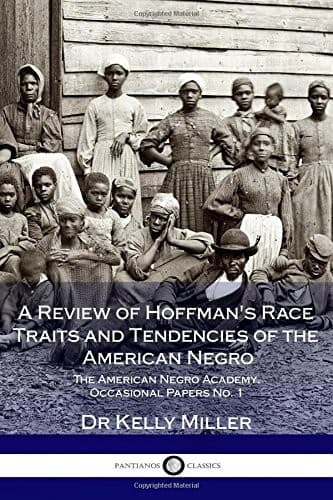
A Review of Hoffman's Race Traits and Tendencies of the American Negro: The American Negro Academy. Occasional Papers No. 1Miller, Kelly
Philosophy
A Review of Hoffman's Race Traits and Tendencies of the American Negro: The American Negro Academy. Occasional Papers No. 1
Miller, Kelly
African Americans; Hoffman, Frederick L. (Frederick Ludwig), 1865-1946. Race traits and tendencies of the American Negro
The social degradation of the Negro is the greatest factor contributive
to this high criminal record. We naturally associate poverty,
ignorance, and crime as being indissolubly connected. The Negroes
represent the stratum of society which commits the bulk of crime the
world over. If we exchange places the same story would be narrated of
the whites. The census records nowhere show that there is any connection
between crime and race, but between crime and condition.
The Negro has a higher criminal record than the Caucasian, it is true,
but so has the foreigner a greater average than the native whites. The
strongest possible argument in this connection rests upon the fact that
the presence of a large number of Negroes in any community does not
increase its total criminal average. The North Atlantic division,
including the states of Maine, New Hampshire, Vermont, Massachusetts,
Rhode Island, Connecticut, New York, New Jersey, and Pennsylvania, has a
criminal record of 833.1 to the million, while the South Atlantic
division, including the states of the Southern Atlantic coast shows a
record of 831.7. The Western division has an average of 1300. The
section that has the fewest Negroes has the highest average, and the
states that have the largest quota of blacks show the lowest criminal
rates. If we compare state with state the same interesting results are
revealed. The criminal record of New York (million basis) is 1369, of
South Carolina 702.6, of California 1703, of Alabama 720.1.
But, says the objector, a difference in the rigidity of the enforcement
of the law may account in some measure for this disparity. Let us then
take the city of Washington, one-third of whose population are Negroes,
and compare its police reports with those of Boston, whose Negro element
is a negligible fraction. It will be conceded, I think, that the
enforcement of law in both cities is rigid. The major of police for the
District of Columbia, in his last report remarks: "Those familiar with
the conduct of police affairs in this country generally contend that
there is a constant increase of crime; that it keeps pace with the
growing population. While such may be true of the principal cities of
the United States, facts and figures support the claim of this
department that in this respect the District of Columbia occupies a
distinct standing of its own. Its comprehensive moral status is above
that of most communities. Were it not for the depredations chargeable to
theft, there would be comparatively little crime to chronicle. This
offense must always exist here, unless through some unexpected agency a
complete change should be effected in the social conditions which
prevail. The abiding place of a large class of idle, illiterate, and
consequently vicious persons, it is but reasonable that the respectable
element should be preyed upon to a considerable extent."[52]
Public-domain text, read in full here on John Shaqi.
Reviews
Reviews
No reviews yet
Be the first to share your thoughts on this work.
Join the Discussion
Join the discussion
Sign in to leave a comment or review.
Sign InorCreate an account