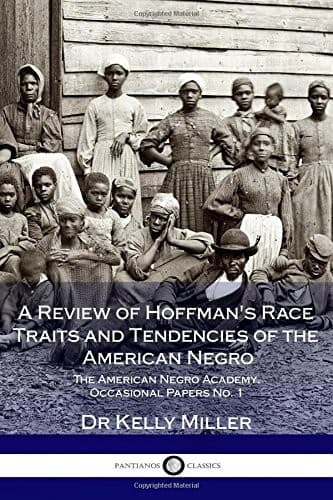
A Review of Hoffman's Race Traits and Tendencies of the American Negro: The American Negro Academy. Occasional Papers No. 1Miller, Kelly
Philosophy
A Review of Hoffman's Race Traits and Tendencies of the American Negro: The American Negro Academy. Occasional Papers No. 1
Miller, Kelly
African Americans; Hoffman, Frederick L. (Frederick Ludwig), 1865-1946. Race traits and tendencies of the American Negro
Baltimore 29,165 38,131 8,966 131
Richmond 14,216 18,138 3,922 128
Atlanta 12,400 15,717 3,317 127
Washington 33,831 41,866 8,035 123
New Orleans 28,936 35,727 6,791 123
Nashville 13,334 16,061 2,727 120
Charleston 14,187 16,849 2,662 119
Savannah 10,493 12,485 1,992 119
Memphis 13,333 15,396 2,063 115
Louisville 13,348 15,324 1,976 115
Philadelphia 18,960 21,414 2,454 113
St. Louis 13,247 13,819 572 104
New York 12,649 13,025 376 103
------ ------ ------ ---
Total 228,099 273,952 45,875 120
Such a disproportion between the sexes can forbode no good to society.
In the West, where the male element predominates over the female among
the white population, the evil effect on society is painfully apparent.
If every colored man in Washington were married and every male minor had
a mate selected for him, there would still be left Negro females enough
to form a manless community larger than Annapolis, Md. Now, no one
should wonder at the moral corruption under these circumstances. These
8000 females, for whom marriage is impossible, be it remembered, are not
restrained by the inhibitory influence of pride, station, and
self-esteem. This is no doubt the greatest evil which threatens the
social integrity of Negro life, and forms the most serious and
perplexing of our city problems.
As startling as the records of crime and immorality are, they are only
the outgrowth of circumstances and conditions. Human nature at best is
weak, and under fostering circumstances has always yielded to the power
of sin and uncleanliness. The author tells us that immorality is a race
trait. This is sadly too true, but it is a human race trait, and is
limited to no particular variety thereof.
CHAPTER VI.
_Subject._ Economic Conditions.
_Gist._ "As a general conclusion it may be said that the Negro has not
yet learned the first element of Anglo-Saxon thrift."[55]
THE NEGRO AS A FARM HAND.
Attempt is made to show that the Negro has deteriorated as a farm
laborer, and that as an industrial factor he has not held his own in the
development of the resources of the South. With a process of reasoning
with which we are fully familiar by this time, these assertions are
sought to be upheld. The decline in agricultural interests throughout
the country has had its effect upon the apparent efficiency of the
farming class everywhere. The mad rush to the cities, with a vain hope
of improvement in condition, has well nigh demoralized agricultural
pursuits.
THE NEGRO AS AN INDUSTRIAL FACTOR.
Public-domain text, read in full here on John Shaqi.
Reviews
Reviews
No reviews yet
Be the first to share your thoughts on this work.
Join the Discussion
Join the discussion
Sign in to leave a comment or review.
Sign InorCreate an account