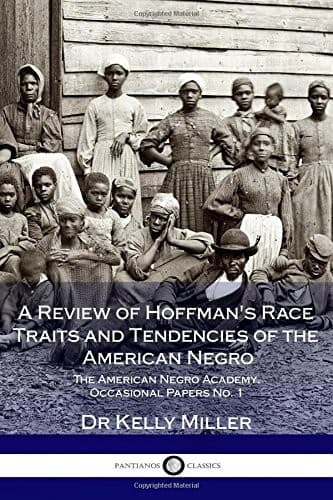
A Review of Hoffman's Race Traits and Tendencies of the American Negro: The American Negro Academy. Occasional Papers No. 1Miller, Kelly
Philosophy
A Review of Hoffman's Race Traits and Tendencies of the American Negro: The American Negro Academy. Occasional Papers No. 1
Miller, Kelly
African Americans; Hoffman, Frederick L. (Frederick Ludwig), 1865-1946. Race traits and tendencies of the American Negro
The investigations which have been undertaken to determine the industrial
efficiency of the Negro have shown results not unfavorable to him. The
recent discharge of white workmen in the cotton mills of Charleston, and
the substitution of colored workmen in their places, is quite significant.
The hindrances which the Negro has to meet in the industrial field are
fully suggested in the address to the public of the discharged white
employes of the Charleston establishment: "If the colored man's status
precludes him from competing with the office-holder, it should exclude
him from competing with our wives, sons, and daughters in the light
pursuits of the country. We affirm, by our physical powers and brave
hearts, not to sit supinely by and witness this Negro horde turned loose
upon the pursuits of our mothers, our wives, our widows, our daughters,
our sisters, and rob them of their living."[56]
This is the solemn declaration of 800 workmen in the metropolis of South
Carolina, and represents fairly the white labor sentiment of the South.
The trades unions and labor organizations preach the same doctrine. If
the alleged low industrial efficiency of the Negro is to be chargeable
to race traits, it should be attributed to the domineering and
intolerant race traits of the white workmen who are not disposed to give
the colored man a fair chance. The fact that in almost every contention
between white and colored workmen the employers take the side of the
Negro, is an eloquent argument in behalf of the industrial merits of the
latter; for these employers are in the business for profit and not for
philanthropy.
ACCUMULATION OF PROPERTY.
The accumulation of property on the part of the blacks shows that in
Georgia they own $12,941,230, in North Carolina $8,018,446, and in
Virginia $13,933,908. The land held by the colored people in Virginia
alone has an area nearly equal to that of the State of Rhode Island.
These facts make a decidedly favorable showing.
CHAPTER VII.
Conclusion.
The need of this chapter is hardly apparent, for the author's conclusion
is as clearly set forth in the beginning as at the close of the
treatise. As to his leading conclusion, the author is not only out of
harmony with the general opinion prevalent among students of the Negro
problem, but is also strangely inconsistent with his former self. The
same author who in 1896, wrote: "It is not in the condition of life, but
in the race traits and tendencies, that we find the cause of excessive
mortality,"[57] in 1892 affirmed: "The colored population is placed at
many disadvantages which it cannot very well remove. The unsanitary
condition of their dwellings, their ignorance of the laws of health, and
general poverty are the principal causes of their high mortality."[58]
The Frederick L. Hoffman of 1892, according to the general judgment, is
much nearer the true analysis than the Frederick L. Hoffman of 1896.
Public-domain text, read in full here on John Shaqi.
Reviews
Reviews
No reviews yet
Be the first to share your thoughts on this work.
Join the Discussion
Join the discussion
Sign in to leave a comment or review.
Sign InorCreate an account