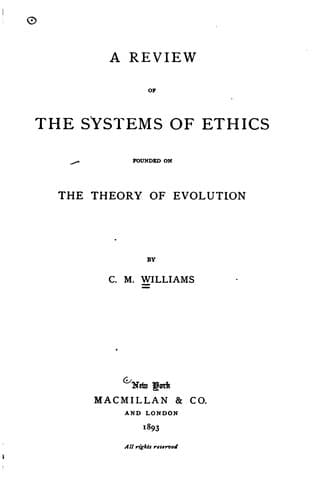
A Review of the Systems of Ethics Founded on the Theory of EvolutionWilliams, Cora May
Philosophy
A Review of the Systems of Ethics Founded on the Theory of Evolution
Williams, Cora May
Ethics, Evolutionary
order,--of the ideas of right and wrong. Inner conflicts can at first
scarcely have occurred, since the possessions of the family were in
common, and a conception of theft between members of the family could
not exist. Furthermore, there was scarcely anything worth stealing, for
the implements must have been so primitive that each individual could
easily manufacture them for himself. Only women could have been, in the
beginning, an object of conflict, and for avoidance of this conflict
laws and customs arose, which are, to our modern minds, inexplicable.
Real polyandry may doubtless be explained by the idea of the common
right of possession among brothers; it has, in most cases, this
significance. It is extended, indeed, later, to more distant relatives,
and gains finally a solemn significance, the presentation of the wife,
or of one of a number of wives, being a symbol of fraternity by which
the guest is honored.
With the manufacture of better tools and weapons, temptation to theft
was increased, and authority began to be directed inwards to the society
itself, since inner conflict injured the family in its contests with
outer enemies. What is true of the family in this connection, is true of
the tribe. A joint egoism of the society as a whole must thus have been
developed, as soon as the first step of association was taken. The
earliest law is always negative, a prohibition, not a positive command.
War had its good as well as its evil side, since it made different
peoples acquainted and gave them knowledge of each other's tools,
weapons, and customs. War was, at first, the only means by which peoples
learned to know each other. The establishment of peace led to the union
of different peoples, or at least to peaceful intercourse by exchange,
which united the tribes by common interests, corrected ideas, and
tempered customs.
The egoistic impulses, the feeling of unconditional right to possession,
are the impulses with which the child is born; morality is not inborn,
but must be developed by education, as is shown by the example of such
children as are neglected in education.[62] Or, if there is anything
innate in the direction of morality, it is merely a certain inherited
predisposition acquired in the course of the thousands of years of
social intercourse, which makes it easier for us to respond to
education. If this is not so, and the impulse to morality is innate, why
has it required so many centuries for man to make the simple connection
of ideas, that what is just towards one man is just towards another. In
this feeling of justice, acquired through an extension of egoism, is the
root of all virtue. It is the spring of sympathy or benevolence, which
can be developed only where the feeling of the like rights of others is
strong.
Public-domain text, read in full here on John Shaqi.
Reviews
Reviews
No reviews yet
Be the first to share your thoughts on this work.
Elsewhere in the archive
Join the Discussion
Join the discussion
Sign in to leave a comment or review.
Sign InorCreate an account