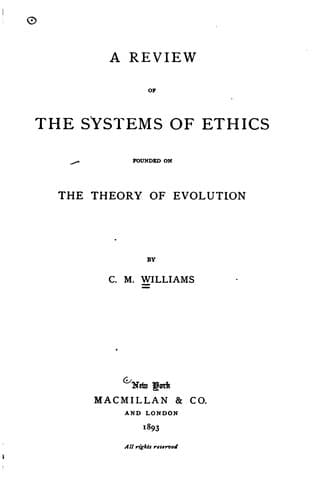
A Review of the Systems of Ethics Founded on the Theory of EvolutionWilliams, Cora May
Philosophy
A Review of the Systems of Ethics Founded on the Theory of Evolution
Williams, Cora May
Ethics, Evolutionary
But an unconsidered over-estimate of this feeling is the source of
Spencer's Utopia, as it is of that of present socialism. We have seen
that authority is a primary and necessary factor of society. Authority,
virtue, and duty are interdependent, and must be of about the same
antiquity. From all compulsion imposed by authority, the creature, by
its nature, attempts to escape, and the feeling which prompts this
attempt has been falsely called the instinct of freedom. Authority
exceeds its bounds, where it issues commands not demanded by the general
conditions existing in the society. But though these conditions may
demand a limitation of personal freedom, their requirements must,
nevertheless, in general, be enforced.
Natural and Humane Ethics may thus be at variance in some things; may in
others, coincide. There is no necessary conflict and no necessary
agreement between them; therefore the theological theory of an absolute
contradiction between them is false, as is also the teleological theory
of their coincidence. The latter theory, not being able to deny that the
moral and the natural do not always coincide under present
circumstances, endeavors to avoid the difficulty by calling these
conditions abnormal. The theory falls into two errors: in the first
place, it ignores the fact that we have our organs, not _for_ use but
_by_ use; and that our inherited characteristics may be regarded as an
adjustment to the conditions of our ancestors, but not an adjustment to
our own; and in the second place, there are no abnormal conditions.
There are new or changed conditions, but either there are no abnormal
ones, or all are abnormal.
But although increase of life means also increase of desire, although
the organism is insatiable, yet there is, as we have seen, an increase
of happiness, both in quantity and quality, with higher organization.
The absolute amount is increased, but not the relative amount, the
amount realizable in proportion to desire.
Want does not lead to improvement, as Darwin maintains, and the
individual cannot be just or sympathetic in a condition of want. The
freer he is from the direct care of the acquirement of necessities, the
more manifold capabilities will he develop, and the greater will be his
happiness.
Public-domain text, read in full here on John Shaqi.
Reviews
Reviews
No reviews yet
Be the first to share your thoughts on this work.
Elsewhere in the archive
Join the Discussion
Join the discussion
Sign in to leave a comment or review.
Sign InorCreate an account