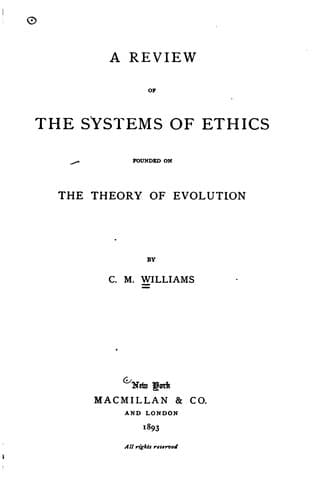
A Review of the Systems of Ethics Founded on the Theory of EvolutionWilliams, Cora May
Philosophy
A Review of the Systems of Ethics Founded on the Theory of Evolution
Williams, Cora May
Ethics, Evolutionary
The task which authority must set itself, in order to secure greater
justice in society, and so greater happiness, is twofold, a positive and
a negative task. The positive task consists in such an education of the
young as will enable them by their own effort to advance towards their
individual ideal of happiness, and in the inculcation of such an ideal
as corresponds to their individual talents and means, and is attainable
under the existing circumstances. The negative task, already implied in
the positive one, is the imposition of necessary restrictions in the
means used for the attainment of happiness. Within the limits set by
justice, the individual has a natural right to seek his own pleasure,
and for each individual an attainable maximum may be reckoned. This is
not saying, however, that the individual has a just claim to this
maximum, in case he cannot, or will not, be sufficiently energetic to
gain it by his own efforts. It is an error of modern times to suppose
that the realization of happiness rests in any other hand than that of
the individual himself--that the state can make and decree happiness.
Happiness cannot be secured by means of decrees, by a division of goods,
or by gifts. Division is always unjust, since it leaves out of
consideration that individuality of character which is the only measure
of sensibility to pleasure. The negative part of the task is to be
accomplished less by inculcation of many special virtues than by the
continual direction of the attention to the fundamental virtue of
justice. The positive task is to be accomplished by the most thorough
education of the intelligence of the individual, through which he shall
learn to inquire the reason of moral precepts, to judge for himself, and
then to act on the decision he arrives at. We have seen that the ethical
education of the present time tends to reduce inner struggle, rendering
the results of wrong-doing as repellant as possible. One in whom has
been instilled a very terrible conception of the sufferings resulting,
in the present and future life, from wrong-doing, will perhaps
automatically avoid the evil; and the means for a moral education seem
thus attained. However, it is not so; for when the individual accustoms
himself to being directed in action, not by his own carefully won
experience, but by feelings instilled by others, concerning the ethical
character of which his own insight does not, and cannot, afford him any
explanation, he opens the way to every chance influence, and becomes the
plaything of unknown forces; while he at the same time divests himself
of that personal responsibility without which no society can exist. The
true ideal of education is such as sharpens the judgment and accustoms
the individual to consider his action from all sides, in the
consciousness of personal responsibility. Only through such action is
man the possessor of freedom. He who acts without reflection, from
unreliable emotion, is not free.
Public-domain text, read in full here on John Shaqi.
Reviews
Reviews
No reviews yet
Be the first to share your thoughts on this work.
Elsewhere in the archive
Join the Discussion
Join the discussion
Sign in to leave a comment or review.
Sign InorCreate an account