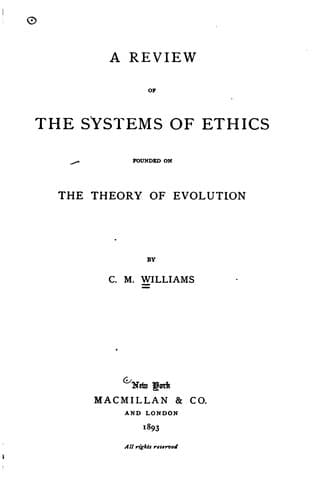
A Review of the Systems of Ethics Founded on the Theory of EvolutionWilliams, Cora May
Philosophy
A Review of the Systems of Ethics Founded on the Theory of Evolution
Williams, Cora May
Ethics, Evolutionary
The freest possible decision is that
which is reached as the result of such a careful consideration of all
the single components of reflection that no one of them exceeds in its
influence its real worth. The ideal of education is not, therefore, the
production of spontaneous decision and action, but of reasoning,
conscious action. That this principle is the only right one is shown by
our former observations, according to which, as society develops, more
and more actions are the result of reflection. And in case a state of
moral perfection is attainable, it can be arrived at only as each member
of the society acts from perfect reflection, not from impulse or
instinct. In attempting social improvement, we must take example by the
chemist, who does not attempt a chemical combination by force but
endeavors to attain the conditions under which the elements will unite,
through their own inner laws, to the desired, homogeneous body. This is
a wearisome process; but it is the shortest and swiftest, for it leads
us to the desired end.
The single virtues cannot be regarded as ideal principles. They
contradict each other, and whether the one or the other should have the
preference depends on the individual case and can be decided only by
reflection. The formulation of these general rules of conduct under the
name of virtues has, practically, only the advantage of reducing the
numberless possibilities of action to a few; but such principles can
never be exhaustive. Wherever the individual forgets this fact and is
led to regard virtue as an end, instead of as the means to an innocent
happiness, virtue ceases to be virtue and becomes its opposite. Thus
thrift becomes avarice, generosity extravagance, courage foolhardiness,
openness want of consideration, gentleness weakness, and chastity
celibacy. The single virtues are only abstractions from special
circumstances generalized to an ideal of action. But in practical life,
we have to do with individual cases whose conditions are by no means
ideal, and cannot be treated as ideal. We must act, in each case, for
the relative best, not for absolute good; and what is best for one sex
or in one society may not be best for the other sex or in another
society. A compromise between idealism and realism is everywhere
necessary; and such a compromise is made, despite all fine words to the
contrary, by every one,--by one only more openly or consciously than
another. It is comforting to remark that mankind shows itself, and
always has shown itself, instinctively taking the road to the attainment
of the end.
Public-domain text, read in full here on John Shaqi.
Reviews
Reviews
No reviews yet
Be the first to share your thoughts on this work.
Elsewhere in the archive
Join the Discussion
Join the discussion
Sign in to leave a comment or review.
Sign InorCreate an account