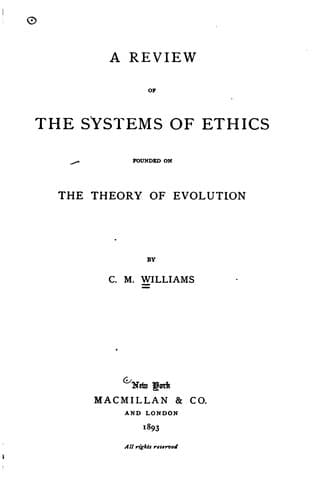
A Review of the Systems of Ethics Founded on the Theory of EvolutionWilliams, Cora May
Philosophy
A Review of the Systems of Ethics Founded on the Theory of Evolution
Williams, Cora May
Ethics, Evolutionary
Through an extension of relations, authority, at first represented by a
single individual, the head of the family or tribe, reaches the point of
development where the one ruler is unable to rule all parts, and decide
all questions, alone, so that he is obliged to call in help. He
naturally chooses men near to him, with whose character he is
acquainted. But there arises, by this division of authority, the danger
of its misuse to the disadvantage of the ruler himself. Since despotic
government depends on might alone, and the voice of the people has no
influence, every person in any way related to the ruler represents a
danger. Nevertheless, the establishment of new powers to assist the
ruler was the starting-point of constitutional government. For by this
division of power the ruler rendered it impossible for himself to govern
without help from others, and opened the way to a contract of compromise
with the people. The influence of individuals upon the state spread,
thus, to the people itself. Self-government, pure parliamentarism, is
the ultimate end to be reached by the process.
We have seen that neither pleasure, nor utility, nor virtue, nor,
finally, religion, can be regarded as the absolute means, but only as
the relative means to the attainment of happiness. Both the hedonist and
the utilitarian need to correct and further define their principle, as
well in respect to the end to be attained, as in respect to the means
proposed. Their principles are not to be rejected, but fanaticism is to
be condemned. Principles may have exceptions; but fanaticism recognizes
no exceptions.
As to man's final end. Though he has attained to the power of shaping,
to some extent, his own environment and means of existence, yet he does
not occupy an exceptional position in the animal kingdom, and must cease
to exist unless he submits to adapt himself. It has been almost the rule
that the highest animals of an epoch have later died out and been
replaced by some new aristocracy, developed from somewhat lower forms.
It is to be supposed that man, also, will be destroyed, whether by a new
ice-age or by a period of heat. By the very fact of his supremacy, he
disturbs the primal equilibrium, and originates conditions which, even
now, press hard upon single lands and may easily become dangerous to all
civilization. Destruction may also threaten mankind morally, for the
development of morality hitherto gives no surety of its continuance.
Every advancement brings with it some evil, every virtue contains the
germs of some vice. Modern humanity has given us an unreasoning
soft-heartedness, with an extravagant malady of forgiveness which is
nothing less than immorality itself, since it on the one hand undermines
the general sense of justice, while on the other it prompts and
encourages wrong-doing.
FOOTNOTES:
[58] For further arguments in support of this assertion, see
"Biologische Probleme," pp. 64-66, etc.
Public-domain text, read in full here on John Shaqi.
Reviews
Reviews
No reviews yet
Be the first to share your thoughts on this work.
Elsewhere in the archive
Join the Discussion
Join the discussion
Sign in to leave a comment or review.
Sign InorCreate an account