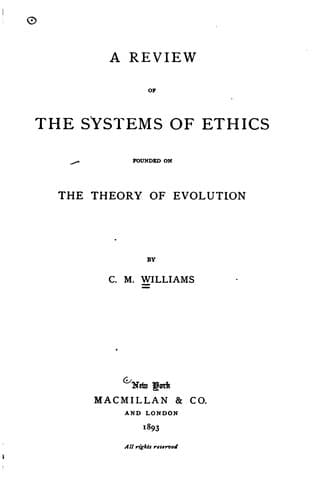
A Review of the Systems of Ethics Founded on the Theory of EvolutionWilliams, Cora May
Philosophy
A Review of the Systems of Ethics Founded on the Theory of Evolution
Williams, Cora May
Ethics, Evolutionary
plates; the motive power of the process of natural selection having been
the construction of cells of due strength and of the proper size and
shape for the larvae, this being effected with the greatest possible
economy of labor and wax; that individual swarm which thus made the best
cells with least labor, and least waste of honey in the secretion of
wax, having succeeded best, and having transmitted their newly acquired
economical instincts to new swarms, which in their turn will have had
the best chance of succeeding in the struggle for existence."[6] And
further, of instinct in general: "It will be universally admitted that
instincts are as important as corporeal structures for the welfare of
each species, under its present conditions of life. Under changed
conditions of life, it is at least possible that slight modifications of
instinct might be profitable to a species; and if it can be shown that
instincts do vary ever so little, then I can see no difficulty in
natural selection preserving and continually accumulating variations of
instinct to any extent that was profitable. It is thus, as I believe,
that all the most complex and wonderful instincts have originated. As
modifications of corporeal structure arise from, and are increased by,
use or habit, and are diminished or lost by disuse, so I do not doubt it
has been with instincts"; though Darwin adds: "But I believe that the
effects of habit are in many cases of subordinate importance to the
effects of the natural selection of what may be called spontaneous
variations of instincts; that is, of variations produced by the same
unknown causes which produce slight deviations of bodily structure."
However, "No complex instinct can possibly be produced through natural
selection, except by the slow and gradual accumulation of numerous
slight, yet profitable, variations."[7] And of habit as connected with
heredity, Darwin writes: "Changed habits produce an inherited effect, as
in the period of the flowering of plants when transported from one
climate to another. With animals the increased use or disuse of parts
has had a more marked influence.... No breeder doubts how strong is the
tendency to inheritance; that like produces like is his fundamental
belief; doubts have been thrown on this principle only by theoretical
writers.... If strange and rare deviations of structure are really
inherited, less strange and commoner deviations may be freely admitted
to be inheritable. Perhaps the correct way of viewing the whole subject
would be to look at the inheritance of every character whatever as the
rule, and non-inheritance as the anomaly.... If it could be shown that
our domestic varieties manifested a strong tendency to reversion--that
is, to lose their acquired characters whilst kept under the same
conditions, and whilst kept in a considerable body, so that free
intercrossing might check, by blending together, any slight deviations
Public-domain text, read in full here on John Shaqi.
Reviews
Reviews
No reviews yet
Be the first to share your thoughts on this work.
Join the Discussion
Join the discussion
Sign in to leave a comment or review.
Sign InorCreate an account