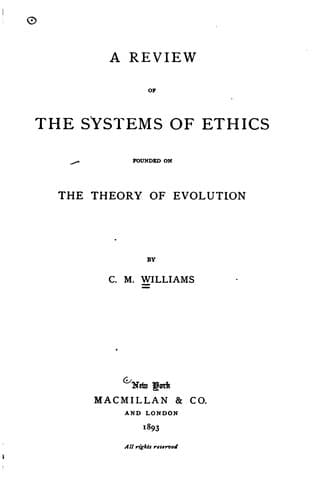
A Review of the Systems of Ethics Founded on the Theory of EvolutionWilliams, Cora May
Philosophy
A Review of the Systems of Ethics Founded on the Theory of Evolution
Williams, Cora May
Ethics, Evolutionary
In the chapter on "Instinct," in "The Origin of Species," Darwin
premises: "I have nothing to do with the origin of the mental powers,
any more than I have with that of life itself."[2] Again: "Frederick
Cuvier and several of the older metaphysicians have compared instinct
with habit. This comparison gives, I think, an accurate notion of the
frame of mind under which an instinctive action is performed, but not
necessarily of its origin.... If we suppose any habitual action to
become inherited--and it can be shown that this does sometimes
happen--then the resemblance between what originally was a habit and an
instinct becomes so close as not to be distinguished.... But it would be
a serious error to suppose that the greater number of instincts have
been acquired by habit in one generation, and then transmitted by
inheritance to succeeding generations. It can be clearly shown that the
most wonderful instincts with which we are acquainted, namely, those of
the hive-bee and of many ants, could not possibly have been acquired by
habit."[3] Of one of the habits of these last-named insects Darwin,
however, writes: "I have not rarely felt that small and trifling
instincts were a greater difficulty on our theory than those which have
so justly excited the wonder of mankind; for an instinct, if really of
no considerable importance in the struggle for life, could not be
modified or formed through natural selection. Perhaps as striking an
instance as can be given is that of the workers of the hive-bee arranged
in files and ventilating, by a peculiar movement of their wings, the
well-closed hive: this ventilation has been artificially imitated, and
as it is carried on even during winter, there can be no doubt that it is
to bring in free air and displace the carbonic acid gas; therefore _it
is in truth indispensable, and we may imagine the stages_--a few bees
first going to the orifice to fan themselves--_by which the instinct
might have been arrived at_."[4] Again: "Glancing at instincts,
marvellous as some are, they offer no greater difficulty than do
corporeal structures on the theory of the natural selection of
successive slight, but profitable modifications. We can thus understand
why nature moves by graduated steps in endowing different animals of
the same class with their several instincts."[5] And again: "As I
believe, the most wonderful of all known instincts, that of the
hive-bee, can be explained by natural selection having taken advantage
of numerous successive, slight modifications of simpler instincts,
natural selection having, by slow degrees, more and more perfectly led
the bees to sweep equal spheres at a given distance from each other in a
double layer, and to build up and excavate the wax along the planes of
intersection; the bees, of course, no more knowing that they swept their
spheres at one particular distance from each other, than they know what
are the several angles of the hexagonal prisms and of the basal rhombic
Public-domain text, read in full here on John Shaqi.
Reviews
Reviews
No reviews yet
Be the first to share your thoughts on this work.
Join the Discussion
Join the discussion
Sign in to leave a comment or review.
Sign InorCreate an account