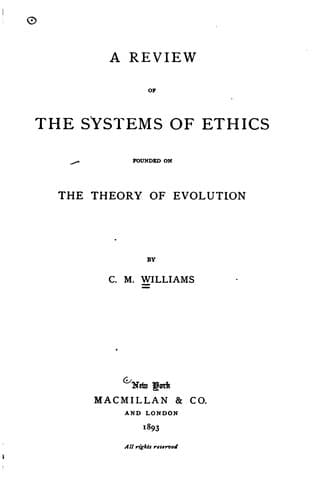
A Review of the Systems of Ethics Founded on the Theory of EvolutionWilliams, Cora May
Philosophy
A Review of the Systems of Ethics Founded on the Theory of Evolution
Williams, Cora May
Ethics, Evolutionary
[59] Und da diese Flaeche durch Zelltheilung oder Fortpflanzung
vergroessert wird, so waechst die Aufnahmefaehigkeit des Organismus mit der
Fortpflanzungsfaehigkeit desselben (p. 67).
[60] Und diese Begierde... ist ihrem innersten Kerne nach, eine Unlust,
ein Leid: das Leid des Entbehrens des Genusses (p. 176).
[61] Bei der Binfachheit der primitiven socialen Verhaeltnisse und der
Einfoermigkeit der Lebenstaetigkeit muessen sich bald Erfahrungsregeln
gebildet haben, die nun durch Vererbung uebertragen und damit zu
Lebensregeln vertieft wurden (p. 195).
[62] Compare _supra_, p. 100, note.
ALFRED BARRATT
Alfred Barratt's "Physical Ethics" (1869) deals with First Principles,
"Pure," as distinguished from "Applied," Ethics, the aim of the science,
as stated by the author, being "to try to establish the first principle
which is the condition of further progress. If we can establish a
principle _a priori_, and then verify its universality by an appeal to
mental phenomena and to philosophical theories, its existence as a fact
will be made certain; if, in addition to this, we can connect it with
laws still more general and with the family of natural sciences, it will
be no longer a fact, but become a scientific law, a section of the
universal code; and the title of this essay will be justified."
_Part First_ of "Physical Ethics" is occupied with the statement of
axioms, definitions, and propositions "derived from general experience."
They are as follows:--
"_Axiom 1._--Actions, like objects, are capable of being classified
according to their properties, and of being measured by a definite
standard.
"_Obs._--This axiom merely means that the qualities of actions, like
those of objects, are fixed and constant, so that the same action has
always the same properties and moral value, and, under the same
circumstances, always produces the same effect.... It follows from this
axiom that it is possible to act so as to attain a definite object, and
thus a general end of action may be arrived at....
"_Axiom 2._--The end of action (being some common property or effect) is
a possible object of knowledge.
"_Axiom 3._--We are capable of being affected by any external object
only through our faculties, or (in other words) as a part of our
consciousness.
"_Axiom 4._--Faculties are known only by their action, or (in other
words) so far as they are portions of our consciousness.
"_Axiom 5._--The sphere of action lies in the adaptation of 'inner' to
'outer' sequences, of faculties to the laws of nature.
"_Axiom 6._--The constitution of man and other animal beings is an
organism consisting of a number of parts, each having its appropriate
function, and the end of each part results from the performance of its
function.
"_Axiom 7._--Approbation is the standard whereby we judge of the moral
value of actions, and is the universal mark of the due performance of a
function and of the attainment of an end."
DEFINITIONS
Public-domain text, read in full here on John Shaqi.
Reviews
Reviews
No reviews yet
Be the first to share your thoughts on this work.
Elsewhere in the archive
Join the Discussion
Join the discussion
Sign in to leave a comment or review.
Sign InorCreate an account