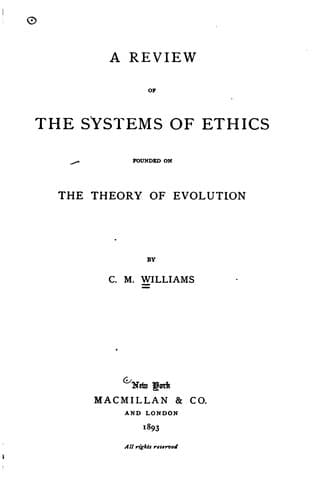
A Review of the Systems of Ethics Founded on the Theory of EvolutionWilliams, Cora May
Philosophy
A Review of the Systems of Ethics Founded on the Theory of Evolution
Williams, Cora May
Ethics, Evolutionary
"1. Good is the object of moral approbation. The highest good is,
therefore, the ultimate object of such approbation, the end of action.
"2. Pleasure is that state of consciousness which follows upon the
unimpeded performance (as such) of its function, by one or more of the
parts of our organism."
PROPOSITION I
"The Good is relative to our faculties. For no object can affect us
except through our faculties (Axiom 3); but to be known by us is to
affect us;
"Therefore, nothing can be known except through our faculties, or (in
other words) except in relation to our faculties;
"But the Good, or End of Action, is a possible object of knowledge
(Axiom 2);
"Hence the Good is relative to our faculties.
"_Corollary 1._--The highest good of man at any time is relative to his
faculties at that time.
"_Corollary 2._--Since ideas derive their elements from experience, the
idea of perfect Good, or God, can only be an idealization of humanity.
PROPOSITION II
"The Good is a state of Consciousness. For, the Good is a possible
object of knowledge (Axiom 2); but all objects of knowledge are states
of consciousness;
"Hence the Good is a state of Consciousness. Or, the Good exists (or is
capable of being known) only by affecting our faculties, or, in other
words, only as an affection of our faculties (Proposition I);
"But an affection of our faculties is a state of consciousness;
"Hence the Good exists only as a state of consciousness.
"_Obs._--... To speak of anything existent external to our
consciousness, is, as we saw, a pure hypothesis, incapable of proof,
perfectly unintelligible and void of utility. When, therefore, we make
use of the ordinary dualistic phraseology, we must remember that the two
worlds there distinguished are merely two divisions of the universe of
self considered as distinct for convenience of language, but differing
only as two classes comprehended under a common genus.
PROPOSITION III
"The Good is relative to circumstances. For, the Good is determined by,
and therefore lies in action (Axioms 7, 6, Obs.); but Action is relative
to circumstances (Axiom 5). Hence the Good is relative to circumstances.
PROPOSITION IV
"The Good depends upon the adaptation of faculties to circumstances.
"For, the Good is identical with the end (Def.); which results from the
performance of function by each part of the organism (Axiom 6).
"But the function of each part is its adaptation to circumstances
(Axioms 5, 6): Hence the Good depends upon the adaptation of faculties
to circumstances.
"_Corollary._--Since man is an organism composed of parts (Axiom 6), the
whole good of man is the sum of the goods of his parts, and therefore
depends upon the adaptation of all his parts to their corresponding
circumstances.
PROPOSITION V
"The Good is Pleasure.
Public-domain text, read in full here on John Shaqi.
Reviews
Reviews
No reviews yet
Be the first to share your thoughts on this work.
Elsewhere in the archive
Join the Discussion
Join the discussion
Sign in to leave a comment or review.
Sign InorCreate an account