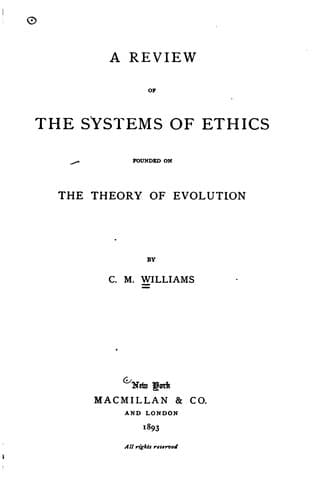
A Review of the Systems of Ethics Founded on the Theory of EvolutionWilliams, Cora May
Philosophy
A Review of the Systems of Ethics Founded on the Theory of Evolution
Williams, Cora May
Ethics, Evolutionary
"For the good results from the due performance of functions (Prop. IV);
but the Good is a state of consciousness (Prop. II), therefore the Good
is the state of consciousness which results from the due performance of
functions (as such). Hence (by Definition), the Good is Pleasure.
"_Obs._--By our definitions of Good and Pleasure it was evident that
they were coextensive, being both marks of the same thing; to prove
their identity it was necessary to show that Good is a state of
consciousness."
Of these propositions Barratt says that I and II are perhaps the most
important, since they assert the impossibility of Transcendentalism.
_Part Second_ of "Physical Ethics" is a "Verification by Special
Experience."
THE ORIGIN OF THE MORAL SENSE
The assumption of a moral sense has already been made in the definition
of Good as the object of Approbation.
Our previous reasoning would lead us nevertheless to guess that this
sense is not, in its nature, a simple and indecomposable faculty. How,
then, did this sense arise, and what is its nature and composition?
In the lowest animal organization, there are merely vague and indefinite
states of consciousness corresponding to the undeveloped state of
physical function. With the development and specialization of advancing
evolution arises Perception; by which likeness and unlikeness among
sensations are distinguished, and classification is begun.
"At first only the most obvious resemblances are noticed, but as
experience progresses, wider and wider classes ever tend to be formed,
till at last we arrive at those highest ideas which are coextensive with
experience. These, though the last in order of birth, become the
starting-points of science--just as men formed the idea of stones
falling long before they discovered the law of attraction, yet by that
law they afterwards 'explain' the former fact. Thus we trace the whole
of Perception or Knowledge to this power of comparison and noting
likenesses, and this we see to be coincident with the organization of
consciousness into central meeting-places or ganglia, in which different
sensations are presented to a common tribunal and so compared together.
We see, therefore, that Perception does not originate consciousness; it
only organizes and develops it. We cannot, therefore, agree with Mr.
Herbert Spencer, who will not allow consciousness to the lowest
animals."[63]
The process of perception or Knowledge works, not only on states of
consciousness themselves, but on the changes from one state to another,
or, in other words, on relations. Thus results, on the one hand,
recognition of objects; on the other, argument and reasoning, for the
most abstruse reasoning is nothing more than a classification of
relations.
Public-domain text, read in full here on John Shaqi.
Reviews
Reviews
No reviews yet
Be the first to share your thoughts on this work.
Elsewhere in the archive
Join the Discussion
Join the discussion
Sign in to leave a comment or review.
Sign InorCreate an account