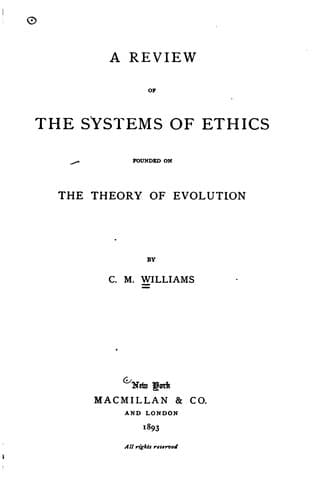
A Review of the Systems of Ethics Founded on the Theory of EvolutionWilliams, Cora May
Philosophy
A Review of the Systems of Ethics Founded on the Theory of Evolution
Williams, Cora May
Ethics, Evolutionary
"We have now, therefore, two distinct divisions of Consciousness:
_Sensation_, which as before consists only of pleasure and pain, though
now of different kinds; and _Perception_, which classifies states of
consciousness and their relations, and is therefore concerned only with
change. Knowledge, therefore, has originally no other object than
different pleasures and pains, but eventually it attends so much to the
differences and resemblances that it ceases to remember the pleasure or
pain; in its absorption in the relation it well-nigh forgets the things
related. This process is furthered by the fact that, as the medium gets
more extended, each part of it has less average effect upon the
organism: the primary pleasures and pains being spread over a larger
surface are less intense, and so obtrude themselves less. This is
exemplified by the common observation that sensation and perception tend
to exclude each other.... Nevertheless pleasure and pain ever remain
indissolubly connected with consciousness, though their presence is
often unheeded, and only the more violent forms force themselves on the
attention.
"What is true of these simple forms of consciousness, is true of their
later development. The relation of sensation to perception is the same
as that between the faculties of which these are respectively the germs,
emotion and intellect. For emotion is associated sensations of pleasure
and pain; and intellect is associated perceptions of change and
relation. Hence by their very nature these are at once mutually
exclusive and inseparable. A strong emotion drives out reason, and much
reasoning chills emotion.... Yet we can give _some_ reason for any
emotion; and we feel some emotion in working a mathematical problem....
In every intentional act it is evident that both are involved; the end
being given by emotion, the means by reasoning. Reasoning can give no
end, it can only arrange, elicit, suggest; emotion can give no means,
for it cannot classify or observe relations. In the building up,
therefore, of any moral faculty, both these elements must take a part.
Hence it will be well to trace, a little more closely, their mode of
formation, and their connection with muscular activity.
"When in the course of experience a certain sequence of sensation
frequently recurs, the consciousness becomes habituated to it, and the
return of the first sensation is followed by an idea or associative
image of the others.... Hence the idea of pleasure or pain not actually
felt comes to be associated with objects, which, if placed in certain
different positions, would effect us in the way imagined.... Pleasure
may thus be associated through a train of ideas of any length.... After
a time this process becomes organic, the intermediate terms are lost,
and pleasure is _directly_ connected with sensations and ideas that are
in themselves not distinctly pleasurable.
Public-domain text, read in full here on John Shaqi.
Reviews
Reviews
No reviews yet
Be the first to share your thoughts on this work.
Elsewhere in the archive
Join the Discussion
Join the discussion
Sign in to leave a comment or review.
Sign InorCreate an account