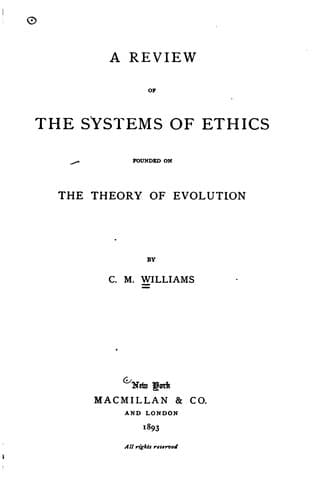
A Review of the Systems of Ethics Founded on the Theory of EvolutionWilliams, Cora May
Philosophy
A Review of the Systems of Ethics Founded on the Theory of Evolution
Williams, Cora May
Ethics, Evolutionary
"Considering them however in their origin, they together represent a
certain form of the transmission of force.... Some kinds of impressed
force are followed by movements of retraction and withdrawal, others by
such as secure a continuance of the impression. These two kinds of
contraction are the phenomena and external marks of pain and pleasure
respectively. Hence the tissue acts so as to secure pleasure and avoid
pain by a law as truly physical and natural as that whereby a needle
turns to the pole, or a tree to the light.... Hence, the law of
Self-Conservation, or of the direction of Action, is merely another mode
of expressing the fundamental property of animal tissue, which we have
every reason to believe is derived from the more elementary physical
properties of matter. The course of action is just as dependent on
physical laws as that of a stone which falls to the ground. The belief
in external consciousness makes no difference either way; the earliest
phenomena of such consciousness are those of pleasure and pain,
therefore we can suppose it to exist only as pleasure and pain. In the
one case we say that action aims at, or naturally results in, the
phenomena of pleasure; in the other case that it aims at the actual
consciousness of pleasure.
"The expression of impressed force, or the connection of action and
sensation, is at first in the unorganized tissue direct and immediate,
without the agency of nervous communication, or to return again to the
ordinary psychological language, is unintentional or involuntary.... The
earliest modification is due to association, whereby secondary
sensations, or (as they are called later when they become perceived)
ideas are produced. These manifest themselves as weaker repetitions of
the primary pleasures and pains, and, therefore, are naturally followed
by like results.... The process is this: the force originally impressed
by the first sensation, instead of being all expressed in action, is
partly induced by habituation into an internal channel, and so
transformed into the kind of force which generally impresses the second
kind of sensation, and this now produces its appropriate action. Hence
part of the original force has undergone two transformations instead of
one; the immediate antecedent of action being the force produced by
association, or in other words, the associated pleasure. This is the
rudiment of _motive_, which, however, is not generally called by that
name till it is _perceived_. The same process may go on through two or
more links of association; the first transformed force being again
transformed internally instead of expressed, and the second again in its
turn, until eventually a transformation is reached which finds its
easiest way of escape in action; the immediate motive power being that
transformation of force, or that associated pleasure, which immediately
precedes the action. Actions of this kind constitute the lower phenomena
Public-domain text, read in full here on John Shaqi.
Reviews
Reviews
No reviews yet
Be the first to share your thoughts on this work.
Elsewhere in the archive
Join the Discussion
Join the discussion
Sign in to leave a comment or review.
Sign InorCreate an account