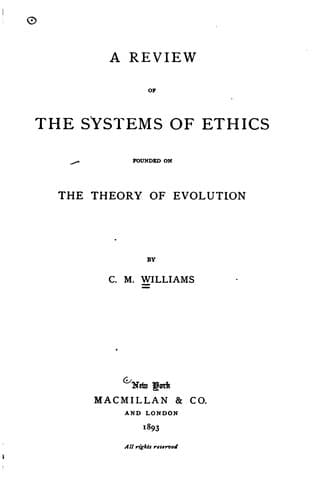
A Review of the Systems of Ethics Founded on the Theory of EvolutionWilliams, Cora May
Philosophy
A Review of the Systems of Ethics Founded on the Theory of Evolution
Williams, Cora May
Ethics, Evolutionary
of instinct: and we see therefore that they may depend on any number of
links of unperceived, or, as we say, unconscious reasoning; and that
their motive is also 'unconscious.' These actions stand half way between
Reflex and Voluntary Actions....
"We now come to the third and last development of associated action.
Here not only is each associated idea perceived, but the change, in each
case, is also a fresh centre of association; whereby similar changes are
connected with it, and it is referred to a class. Hence the whole train
is perceived, not only by the classification of each of its parts with
similar previous sensations, but by the classification of each of its
sequences with previous like sequences: in other words, it is now a
chain of reasoning from the past to the present. That associated
pleasure from which this reasoned train commences is now called the
_motive_ (though really the immediate motive power lies in the last
transformation which directly precedes the active expression) and the
series of ideas intervening between this and the action is called the
_means_. Hence the motive associates the means, and the motive power is
transmitted through them till it is finally expressed in the action
which is appropriate to the attainment of the pleasurable state whose
idea is its source. This association of means with ends is at first
sight opposed to the natural direction, which is from antecedent to
consequent; but when a line of nervous connection is formed, a current
may be transmitted indifferently in either direction. An effect may lead
us to think of its cause, as easily as a cause associates its effect.
By the sequence of action and sensation, a connection is established
between their ideas, which is independent of the order of excitation.
This last kind of action is that which we call voluntary, and the series
of classified ideas and relations which lead to it is called Reasoning.
If at any point the current is attracted in two or more directions by
different trains of association, deliberation is the result; and the
eventual victory of one and the consequent transmission of the force
along it is entitled Will.
Public-domain text, read in full here on John Shaqi.
Reviews
Reviews
No reviews yet
Be the first to share your thoughts on this work.
Elsewhere in the archive
Join the Discussion
Join the discussion
Sign in to leave a comment or review.
Sign InorCreate an account