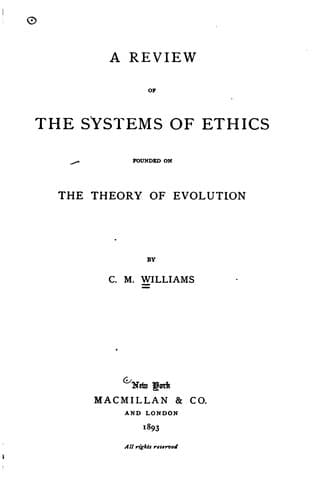
A Review of the Systems of Ethics Founded on the Theory of EvolutionWilliams, Cora May
Philosophy
A Review of the Systems of Ethics Founded on the Theory of Evolution
Williams, Cora May
Ethics, Evolutionary
"We have therefore distinguished four kinds of action: _Reflex Action_,
which is purely physical and independent of association, and which is
the last link in all the derived varieties; _Lower Instinctive Action_,
which is caused by the first introduction of association, and is hardly
to be distinguished in its phenomena from the last;... _Higher
Instinctive Action_, which involves perception of qualities or
objects;... and finally, _Voluntary_ or _Intentional Action_, such as we
find it in man.... Though we have separated these classes from each
other for clearness of description, there is no distinct line to be
drawn anywhere between them. Each fades insensibly into the next....
Evolution, we must remember, does not advance by stages; these are
merely marks that we make ourselves, like the constellations in
astronomy, for convenience of study.
"Finally, we must remark that the last two kinds of Action ever tend to
relapse into the second, which subjectively is a mere form of the first.
Association of all kinds tends to become organic. By this we mean that,
as the connection becomes more definitely marked and easy, the perpetual
radiation which occurs as the current passes the different points on its
path, disappears; and the whole current passes unimpaired. First, the
radiation caused by the changes disappears, and reasoning becomes
instinct, as in doing a mathematical example from mere memory of the
different steps. Secondly, the radiation from the different nervous
centres also disappears, and the current which ends in action becomes
not only unreasoning but unperceived, as in walking or reading aloud
while thinking of something else....
"Long habituation has two effects: it increases the number of trains
connected with each object, and also the length of each. If we suppose
the simpler emotions to have, by this time, become organic or apparently
simple states of consciousness, a continuance of association tends to
connect them together in bundles, as they themselves were originally
bundles of elementary pleasures and pains. Hence the emotions become
organized in their turn so as to form higher emotions, and eventually,
when association has completed its work,... this organization ends in
one supreme emotion, which is the head of the emotional or sensitive
side of the consciousness....
Public-domain text, read in full here on John Shaqi.
Reviews
Reviews
No reviews yet
Be the first to share your thoughts on this work.
Elsewhere in the archive
Join the Discussion
Join the discussion
Sign in to leave a comment or review.
Sign InorCreate an account