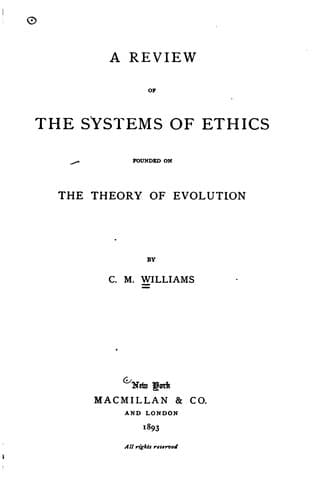
A Review of the Systems of Ethics Founded on the Theory of EvolutionWilliams, Cora May
Philosophy
A Review of the Systems of Ethics Founded on the Theory of Evolution
Williams, Cora May
Ethics, Evolutionary
"Turning next to the second effect of prolonged habituation, we find
that, with objects or actions with which pleasure was at first
associated and which so were called pleasurable, further association
often connects a subsequent pain which increased experience has shown
always to follow upon the immediate pleasure. This pain often more than
counterbalances the preceding pleasure; hence when it is taken into the
emotion, that emotion becomes one no longer of appetition but of
aversion, and the object or action is remembered as one not to be sought
after but avoided. It cannot, however, be called painful, because it
causes immediate pleasure, so a new name has to be invented, and it is
called Bad, or Evil. Similarly, many things which are immediately
associated with pain are found to be eventually followed by pleasure
which more than counterbalances the pain, and as this experience becomes
consolidated by the power of association, they attract rather than
repel, and for a name whereby to distinguish them, are called Good; so
that Good and Evil are correlative terms like Pleasure and Pain, and
mean respectively the greatest total Pleasure, and the greatest total
Pain. Now this experience when once acquired is never lost, but by
virtue of hereditary transmission descends from parents to children.
But, as in the case of the simpler emotions, only the results survive,
and not the means whereby they were arrived at; so that, in a short
time, the words Good and Evil come to be quite separated from Pleasant
and Painful; nay, as might be expected from their origin, they tend to
acquire exactly opposite meanings; for Pleasure and Pain come to signify
only immediate pleasure and pain; and the final reckoning is often
considerably at variance with the first item; as in a race the man who
leads for the first lap seldom wins in the end....
"This, then, is the origin of the Moral Sense.... The Moral Sense,
therefore, is merely one of the emotions," though the last of all in the
order of evolution; it can only claim a life of some two or three
centuries; and there are even some who still doubt its existence. "Man
at any rate is the only animal who possesses it in its latest
development; for even in horses and dogs we cannot believe that it has
passed the intentional or conscious stage.... Good, with them, has no
artificial meaning; it is simply identical with the greatest pleasure."
Only by complete and perfect obedience to all emotions can perfect
freedom from regret be obtained in the gratification of all desire. Man
is at present passion's slave, because he is so only in part; "for the
cause of repentance is never the attainment of some pleasure, but always
the non-attainment of more: not the satisfaction of one desire, but the
inability to satisfy all. The highest virtue, therefore, consists in
being led, not by one desire, but by all; in the complete organization
of the Moral Nature."
OF THE SOCIAL RELATION OF THE INDIVIDUAL
Public-domain text, read in full here on John Shaqi.
Reviews
Reviews
No reviews yet
Be the first to share your thoughts on this work.
Elsewhere in the archive
Join the Discussion
Join the discussion
Sign in to leave a comment or review.
Sign InorCreate an account