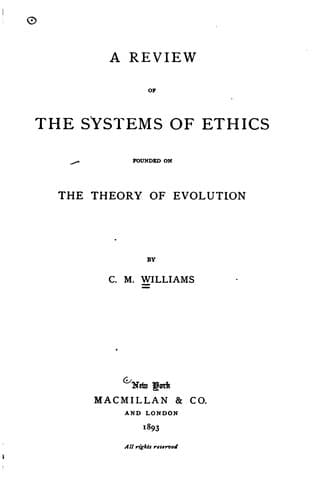
A Review of the Systems of Ethics Founded on the Theory of EvolutionWilliams, Cora May
Philosophy
A Review of the Systems of Ethics Founded on the Theory of Evolution
Williams, Cora May
Ethics, Evolutionary
When we assert the end of Action to be Pleasure, do we mean the pleasure
of the individual, or universal happiness? "Good has been shown to
follow immediately on the adaptation of an organism to circumstances; it
is evident that external objects can affect it only in so far as they
form part of these circumstances. Hence it follows that the pleasure and
pain of others can come in only incidentally; from the fact that each
man is not an isolated unit, but a member of society. But further, this
social medium itself is, after all, nothing but a part of the individual
affected by it; it is one division of that primary side of his nature,
by which the other side, the emotional, the intellectual, the moral, is
being continually moulded and fashioned; and even if we take the
narrower meaning of self, the pleasures and pains of others cannot
possibly affect a man's actions or emotions except in so far as they
become a part of his. If man aims at pleasure merely by the physical law
of action, that pleasure must evidently be ultimately his own; and
whether it be or be not preceded by phenomena which he calls the
pleasures and pains of others, is a question not of principle but of
detail, just as the force of a pound weight is unaltered whether it be
composed of lead or of feathers, or whether it act directly or through
pulleys.
"The principle, therefore, is clear enough, that the happiness of others
can have only an indirect influence upon the good of each individual.
But it is equally clear that this direct influence must be of no mean
extent, and that it is now our duty to trace its history." Here follows
a scheme of the development of the state from the family, which last was
necessitated by the helplessness of infancy, and from which arose the
habit of human association. We have no evidence from history or science
that mankind has not always existed in a state of society; there is no
warrant for assuming an earlier condition of isolation. "Hence to the
human race the earliest Good was inseparably bound up with what we now
call the Family Virtues."[64] The state, thus originated, developed as a
social organism, with ever greater integration, heterogeneity, and
complexity of parts, and "the End or Good of each individual became
largely modified by the extension of the medium to which his actions had
to be adapted"; man became a member, not only of the family but of the
state, and the conceptions of his nature and duty became wider, "so that
at last the more perfectly each attains his own interest, and the more
pleasure he gathers to his own store, the more certainly does he secure
the universal happiness of mankind." If a man aims, as Spinoza remarks,
at doing real good to himself, he will be sure to do most good to
others.
THE UNSELFISH EMOTIONS
Public-domain text, read in full here on John Shaqi.
Reviews
Reviews
No reviews yet
Be the first to share your thoughts on this work.
Elsewhere in the archive
Join the Discussion
Join the discussion
Sign in to leave a comment or review.
Sign InorCreate an account