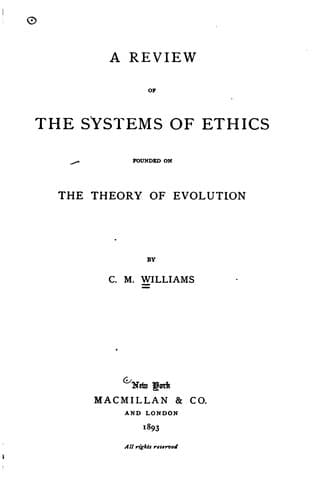
A Review of the Systems of Ethics Founded on the Theory of EvolutionWilliams, Cora May
Philosophy
A Review of the Systems of Ethics Founded on the Theory of Evolution
Williams, Cora May
Ethics, Evolutionary
Under this head is traced the genesis of sympathy through representation
of the pains and pleasures of others and interpretation of them by
individual experience in the same environment; and the genesis of
benevolence, the active side of sympathy, through habit associated with
the ideas of the pleasures and pains of others. Love is defined as
"originally the association of many pleasures with one individual." From
the wider experience of man as a member of a state is developed justice
or the sense of equality of right, patriotism, etc. All these feelings
are hereditary.
OF THE RELATION OF MAN TO NATURE
This portion of the book treats of the gradual development of knowledge
to wider and wider generalization; of the extension of sympathy from man
to the animal world also; of the universality of consciousness, which
exists in the inanimate as well as the animate world; of the perfection
of morality through the perfection of knowledge, since "knowledge moulds
emotion, and absolute virtue is nothing but absolute correspondence with
nature in action resulting from thought"; and of the evolution of
religion, through knowledge, to a religion of knowledge of the real
universe or of humanity.
OF THE WILL
Under this heading the metaphysical doctrine of freedom of the will is
combated as a contradiction of the laws of Cause and Effect. Praise and
blame, reward and punishment, are desirable because of their effect on
action.
OF OBLIGATION
Barratt defines obligation as a "violent motive." Paley says: "If a man
finds the pleasure of sin to exceed the remorse of conscience, of which
he alone is the judge, the moral-instinct man, so far as I can
understand, has nothing more to offer." What, then, asks Barratt, has he
himself to offer if a man finds the pleasure of sin to exceed the pain
entailed by disobedience to the external command? It may, indeed, be the
fact that particular kinds of motive only come from particular sources,
but unless we can prove that those coming from a command are always the
strongest, we cannot claim for them a position such as that implied by
the word obligation, of being the highest or most universal motives. In
a contest between two motives, it is not the kind but the quantity which
decides. For if two pleasures or pains be equal, what does it matter
where they came from? And if they be not equal, the greater, whatever
its source, will always be the stronger motive.
"Hence obligation is nothing more than a 'violent motive.' Prudence and
duty are both the following of the greatest pleasure; but so far as in
ordinary language we make a distinction between them, the pleasure aimed
at in prudence is proximate and only slightly greater than the pain,
whereas in duty it is not only very considerably greater, but the
greatness is further glorified by a dim aureole of magnificent
generalities and the halo of an unfathomable future....
Public-domain text, read in full here on John Shaqi.
Reviews
Reviews
No reviews yet
Be the first to share your thoughts on this work.
Elsewhere in the archive
Join the Discussion
Join the discussion
Sign in to leave a comment or review.
Sign InorCreate an account