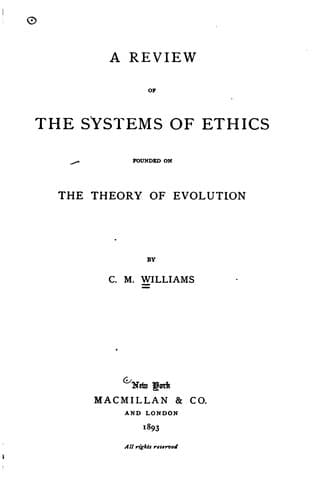
A Review of the Systems of Ethics Founded on the Theory of EvolutionWilliams, Cora May
Philosophy
A Review of the Systems of Ethics Founded on the Theory of Evolution
Williams, Cora May
Ethics, Evolutionary
Leaving aside metaphysical questions, however, we may be able to find,
as in physical science, some constants or ultimate elements which,
though they, according to the metaphysician's view, require further
analysis, yet constitute, within their sphere, scientific knowledge
independent of metaphysics. The follower of Hegel means, in all
probability, precisely the same thing as the follower of Hume, when he
says that a mother loves her child; though, when they come to reflect
upon certain ulterior imports of the phrases used, they may come to
different conclusions. The formula remains the same; for all purposes of
conduct it evokes the same impressions, sentiments, and sensible images,
and it therefore represents a stage at which all theories must coincide,
though they start, or profess to start, from the most opposite bases.
"Mothers love their children" is not unconditionally true; some mothers
do not love their children; but the statement is of worth as
approximating scientific truth. It may be well to attempt to ascertain
in how far it may be rendered scientific.
In the physical sciences, the statements of laws arrived at by the labor
of generations are ideal statements, in which a mass of modifying
circumstances are disregarded for the sake of simplification. Even in
these sciences, the power of prediction is small. Of the complicated
conditions of human action we have even less accurate knowledge than of
those of physical phenomena, though this does not lead us, any more than
in the physical sciences, to suppose that prediction would not be
possible if we knew the conditions. So far as man is a thing or an
animal, it is comparatively easy to determine his conduct. Given a
starving dog and a lump of meat in contact, you can predict the result.
But to determine the behavior of a human being with a glass of water
presented to his lips, you must be able to calculate the action of human
motive and to unravel the tangled skein of thought and feeling in its
variation in the individual under consideration. Moreover, much of the
life of the individual is ruled, not by conscious motive, but by
automatic habit, acquired through education. The prediction of action in
society as a unit is not less difficult than the prediction of
individual action, for if individual differences neutralize each other,
so that a certain uniformity in the influence of circumstances is shown
by statistics, it is not the less difficult to predict what these
uniformities will be. Society as an organism, not a mere aggregate,
presents, in the interaction of more complicated conditions, greater
difficulties than does the individual as such; and it may be said that
prediction of the course of history, even in general terms and for a
brief period, would require an intellect as much superior to that of
Socrates as the intellect of Socrates is superior to that of an ape.
Public-domain text, read in full here on John Shaqi.
Reviews
Reviews
No reviews yet
Be the first to share your thoughts on this work.
Elsewhere in the archive
Join the Discussion
Join the discussion
Sign in to leave a comment or review.
Sign InorCreate an account