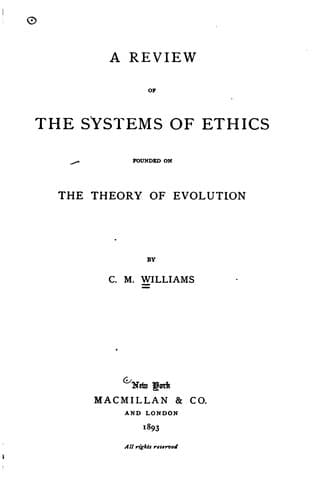
A Review of the Systems of Ethics Founded on the Theory of EvolutionWilliams, Cora May
Philosophy
A Review of the Systems of Ethics Founded on the Theory of Evolution
Williams, Cora May
Ethics, Evolutionary
And yet mankind does possess knowledge of conduct, which does not differ
in kind from scientific knowledge; there is, in fact, but one kind of
knowledge, which passes into scientific knowledge as it becomes more
definite and articulate. The knowledge that mankind possesses consists
in what we have thus far taken for granted, that under the same
circumstances of outward environment and inward character, human conduct
does not change. Of society, as of an organism, we cannot say _a priori_
that it is so and could not have been otherwise; we can only show, _a
posteriori_, how different parts mutually imply each other, so that,
given the whole, we can see that any particular part could not have been
otherwise. Our gain from such knowledge is the recognition that there
may be discoverable laws of growth essentially relevant to our
investigation of conduct. So long as reasoning was conducted upon the
tacit assumption that social phenomena can be satisfactorily explained
by studying their constituent elements separately, attention was
diverted from the important principles of the interrelation of parts to
the whole. The theory of evolution brings out the fact that every
organism, whether social or individual, represents the product of an
indefinite series of adjustments between it and its environment. Every
race or society is part of a larger system, product of the continuous
play of a number of forces constantly shifting with an effort towards
general equilibrium, so that every permanent property represents, not an
accidental similarity, but a correspondence between the organism and
some permanent conditions of life. To solve the problem of existence by
calculation is an impossibility; but our own lives are working it out;
the evolution of history is the solution of our problem. And when we
fully recognize that a problem is being solved, we have only to gain
some appreciation of its general nature and conditions, in order to
reach some important, though limited, conclusions, which may fairly be
called scientific, as to the meaning of the answer. These conclusions
are not scientific in the sense of giving us quantitative and precise
formulae, but they may be so far scientific as to be certain and
reliable.
Thus we may be able to show how a given set of instincts corresponds to
certain permanent conditions under which they were developed, and
(returning to the problem of differing theories of morals with which we
started) to show what is the cause of differing opinions. Our
investigations of the problem of morality have nothing to do, in the
first instance, with moral principles which are, or profess to be,
deduced from pure logic, independent of any particular fact; they deal
with actual moral sentiments as historical facts. The word moral, as
used in our considerations, does not, therefore, refer to an ideal moral
code, but to the one actually existing in the case considered.
Public-domain text, read in full here on John Shaqi.
Reviews
Reviews
No reviews yet
Be the first to share your thoughts on this work.
Elsewhere in the archive
Join the Discussion
Join the discussion
Sign in to leave a comment or review.
Sign InorCreate an account