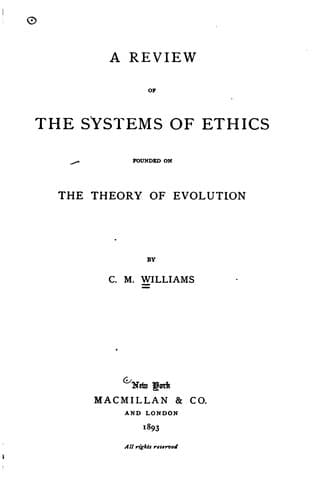
A Review of the Systems of Ethics Founded on the Theory of EvolutionWilliams, Cora May
Philosophy
A Review of the Systems of Ethics Founded on the Theory of Evolution
Williams, Cora May
Ethics, Evolutionary
Ethical speculation, as thus understood, must be concerned with
psychological inquiries--inquiries in regions where the vague doctrines
of common sense have not yet crystallized into scientific coherence; we
must therefore proceed with caution.
The contention between materialist and idealist is irrelevant to our
discussion. The fact that mechanical processes underlie all mental
process does not make the latter the less a fact; nor can the mechanical
statement ever supersede the psychological statement. The proposition
that hunger makes men eat will express truth, whatever material
implications are involved in the statement.
Conduct is determined by feeling; we fly from pain, we seek pleasure;
life is a continuous struggle to minimize suffering and lay a firm grasp
upon happiness. "Good" means everything that favors happiness, and "bad"
everything that is conducive to misery; nor can any other intelligible
meaning be assigned to the words. The difficulty of proving these
propositions lies in the fact that they are primary doctrines, for proof
of which we must appeal to the direct testimony of consciousness. But
critics oppose, not so much the propositions themselves, as certain
supposed implications. By pain and pleasure is here meant every
conceivable form of agreeable or disagreeable feeling. The assertion
that conduct is determined by pain and pleasure is not meant as a denial
that it is also, in some sense, determined by the reason; but a state of
consciousness which is neither painful or pleasurable cannot be an
object of desire or aversion. The reason is often contrasted with the
feelings in its determination of conduct, the reasonable man being
defined as one who, instead of being the slave of immediate impulse, is
capable of adapting means to ends and following, thus, courses of
conduct not in themselves agreeable but promising a greater total of
happiness. The fact is, however, that all happiness that determines the
will is future; conduct is determined, in every case, not by a future
feeling of pleasure, which, as future, does not yet exist, but by
present feeling. It is therefore more accurate to say that conduct is
determined by the pleasantest judgment than to say that it is determined
by the judgment of what is pleasantest. The intention of the agent is
defined by the foreseen consequences of his conduct; his end is defined
by that part of the foreseen consequences which he actually desires; and
the end defines the motive, that is, the feeling, which actually
determines conduct. The pleasantest end is adopted because the foretaste
of the pleasure is itself pleasurable. The intellect and the emotions
are in reality related as form and substance, and cannot be divided.
Public-domain text, read in full here on John Shaqi.
Reviews
Reviews
No reviews yet
Be the first to share your thoughts on this work.
Elsewhere in the archive
Join the Discussion
Join the discussion
Sign in to leave a comment or review.
Sign InorCreate an account