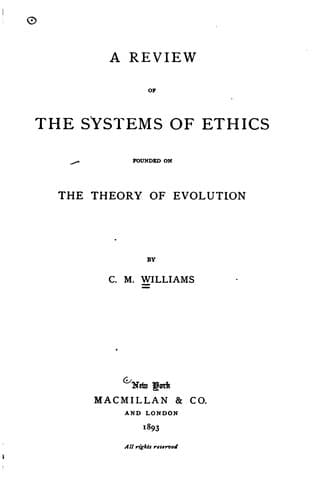
A Review of the Systems of Ethics Founded on the Theory of EvolutionWilliams, Cora May
Philosophy
A Review of the Systems of Ethics Founded on the Theory of Evolution
Williams, Cora May
Ethics, Evolutionary
In the action of pain and pleasure, it seems to be an obvious fact that
pain, as pain, represents tension, that is, a state of feeling from
which there is a tendency to change; pleasure represents equilibrium, or
a state in which there is a tendency to persist. The worm writhes on the
hook, and the mind may be said to writhe under a painful emotion in the
effort to writhe into some more tolerable position. In the act of
choice, each mode of action is tried ideally, and the individual settles
into that which is, on the whole, the easiest. The analogy which
naturally offers itself and seems to give the best account of the facts
is the mechanical principle of least resistance. It is not, perhaps,
superfluous to remark that the volition may exercise a very small
influence, even when the limiting conditions are in a great part ideal.
The more painful is not necessarily the less permanent condition. It is
one in which there is an additional chance against permanence. Terror
sets up so disturbed a condition that the mind cannot settle into any
definite course. We can no more alter arbitrarily the circumstances of
our microcosm than those of the external world. It is as difficult to
avoid brooding in vain regret as to evade a physical constraint.
Reason and feeling are bound together in inseparable unity. But reason,
whatever its nature, is the faculty which enables us to act with a view
to the distant and the future. A great part of conduct is automatic; it
is either not determined by conscious motives, or it is determined by
motives which, though they rise for a moment to the surface of
consciousness, are forgotten as soon as felt. Of our conscious conduct,
again, part may be called instinctive and part reasonable. These modes
of action pass into each other by imperceptible degrees. The instinctive
may be converted into reasoned as the consequences become manifest, and
the reasoned become instinctive as the consequences are left out of
account. So, again, the instinctive action becomes automatic when it is
performed without leaving any trace upon consciousness. It may still be
voluntary in the sense that the agent may be able to refrain from it if
his attention happens to be aroused. Habitual actions pass through all
these gradations. When the reason is called into action, it is not in
virtue of a purely logical operation that it conquers if it does so; it
is in virtue of the fact that it reveals a new set of forces ready to
spring into action to the necessary degree.
We may be said to feel by signs as well as to reason by signs. The sight
of a red flag may deter us from crossing a rifle range without calling
up to our imagination all the effects of a bullet traversing the body.
If the motive which prompts us to run the risk be strong, it may be
necessary to convert a greater volume of latent, into active emotion;
and as we frequently fail to do this, we often run risks which we should
avoid were the consequences distinctly contemplated.
Public-domain text, read in full here on John Shaqi.
Reviews
Reviews
No reviews yet
Be the first to share your thoughts on this work.
Elsewhere in the archive
Join the Discussion
Join the discussion
Sign in to leave a comment or review.
Sign InorCreate an account