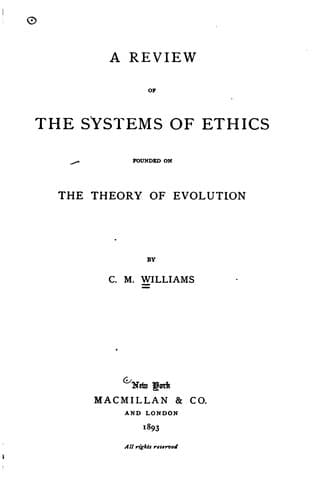
A Review of the Systems of Ethics Founded on the Theory of EvolutionWilliams, Cora May
Philosophy
A Review of the Systems of Ethics Founded on the Theory of Evolution
Williams, Cora May
Ethics, Evolutionary
The will may be defined, not as a definite, separate power, but as the
self-conscious impulse to action resulting from excitation. Any other
definition is inconsistent with the theory of evolution, according to
which that individuation which is the first condition of the struggle
for existence, is nevertheless but the expression of all previously
existing oppositions. To make of the will or of the impulse to
self-preservation anything separate and individual, is as childish as to
personify death. The individual is totality as unity. Darwinism teaches
us, not that the world together with man has been created according to
any teleological principle, but that it has developed by virtue of
motion. The human being moves by virtue of reciprocal action and
reaction with the world. Yet only by virtue of his unity as feeling does
he think and will. Individuality is that which stamps all our activity
with the mark of the ego, which causes us to recognize every impulse
that moves in us as our impulse, to call all our willing ours. The
psychical, the summation of functions to which we give this name,
reaches consummation in the clarification of feeling to consciousness,
in which the desire of an action or of abstinence from an action appears
to us as our will. As thought is based on perception, so will is based
on impulse; and since thought and will appear as the two highest
opposites of feeling, and this, according to our definition, springs
from sensation by way of perception, the will, including action and
abstinence from action, arises out of the general sensitivity. The
progress of science authorizes the expectation that the close relation
of sensitivity to simple reaction will one day be discovered.
The conceptions of teleology are groundless. The so-called "ends" of
nature have the peculiarity that they are according to the means. It
does not rain in order that there may be vegetation, but vegetation
exists because it is conditioned by the rain. Only with thinking man, in
his struggle for existence, arises the concept of ends; man has not
attained to civilization by help of a friend; rather has he wrung
civilization from nature as an enemy; compelled by it to the exertion of
his whole strength, and growing in cunning by exercise, he has learned
to use the weaknesses of his foe to his own advantage. To want he owes
the greatest things that he has accomplished. By way of labor alone can
victory over nature be achieved and salvation won.
Public-domain text, read in full here on John Shaqi.
Reviews
Reviews
No reviews yet
Be the first to share your thoughts on this work.
Elsewhere in the archive
Join the Discussion
Join the discussion
Sign in to leave a comment or review.
Sign InorCreate an account