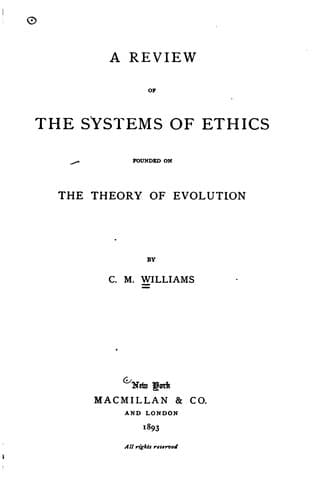
A Review of the Systems of Ethics Founded on the Theory of EvolutionWilliams, Cora May
Philosophy
A Review of the Systems of Ethics Founded on the Theory of Evolution
Williams, Cora May
Ethics, Evolutionary
The standpoint of faith is childlike. Faith does not reason, and may not
do so if it wishes to remain faith. The child can comprehend nature and
man's relation to it only by the language of faith, and there are large
classes of people who, for a long time, will be accessible to no other
language but this. But faith must decrease in the same ratio as mankind
outgrows intellectual childhood. In the same measure, the worth of the
philosophical solution of certain problems must increase; and among the
most important of these problems must be reckoned that of bridging the
chasm between the individual and the world, which has grown wider with
the awakening of consciousness. It lies in the nature of self-conscious
thought to reach out beyond itself, just as it lies in the nature of
sense-perception to regard this "beyond" as the world to come. Hence the
endless longing which seeks the ruler of the world to come, and despairs
without him; until the supposed right to a future life is perceived to
be the right to the Only Whole, and an end is set in the attainment of
this whole. For the thinking man an aimless life has no meaning; there
is only one means of bridging the chasm; namely, that mankind shall set
itself an end.
A final destruction of life upon the earth must surely come, whether it
be in the shape of a sudden catastrophe or as the result of a slow
process. But such an end can no more be regarded as the "end" in the
philosophical sense than death can be regarded, in the same sense, as
the "end" of the individual life. By the development of ideas, which are
concepts of reason in distinction from concepts of the understanding, we
arrive at a notion of the ideal as end.
In the ethical ideal, there is contained more than the empiricist can
offer. The enthusiasm with which the true artist starves for his art, or
the martyr perishes for his conviction, can never be fully explained
from the empirical standpoint. One does not even need to be an idealist
in order to act thus; but the materialist or the realist who possesses
true love of beauty and a heart framed for great deeds, merely deceives
himself when he refuses to acknowledge the All-embracing which therein
overwhelms him. Sociology and the History of Civilization can only point
out how man has attained to the ideas of the Beautiful and the Good;
what these are and wherefore their influence is so powerful,--the real
worth of the Beautiful and the Good,--thought by concepts alone can
show.
The Idea of Man, as he has already developed and may yet develop, is, as
far as our knowledge reaches, the highest of human thoughts. We are
therefore formulating no metaphysical theory in personifying mankind,
and pointing out that the perfecting of which it is capable is the great
end which it has set itself. We know, by our knowledge of human nature,
that mankind will always endeavor to be happy, and that it will approach
nearer perfection the more real and general its happiness becomes.
Public-domain text, read in full here on John Shaqi.
Reviews
Reviews
No reviews yet
Be the first to share your thoughts on this work.
Elsewhere in the archive
Join the Discussion
Join the discussion
Sign in to leave a comment or review.
Sign InorCreate an account