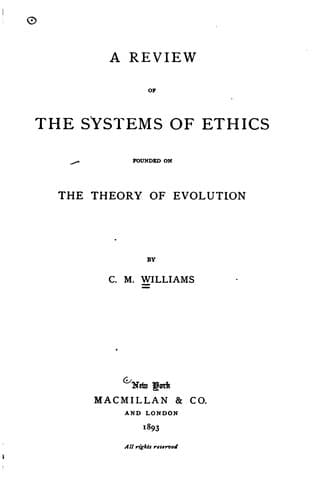
A Review of the Systems of Ethics Founded on the Theory of EvolutionWilliams, Cora May
Philosophy
A Review of the Systems of Ethics Founded on the Theory of Evolution
Williams, Cora May
Ethics, Evolutionary
The particular rules of morality may and must change; but the highest
principle of all morality is changeless. From the purest moral feeling
came Schiller's words: "Live with thy generation, but be not its
creature; serve thy contemporaries, but in that which they need, not
that which they prize. Without having shared their guilt, share with
noble resignation their punishments, and yield thyself freely to the
yoke which they both illy could do without and illy bear. By the
steadfast courage with which thou refusest their pleasure, thou shalt
prove to them that it is not cowardice which causes thy submission." In
these three sentences there lies a whole system of ethics.
In the will to good, indivisible from a feeling of freedom, of which no
power on earth can rob us, lies true happiness.
For mind, as for matter, the law of the indestructibility of force, of
work, is true. That which appears as force or energy is motion; every
impulse to motion is motion, and only in so far as it appears, can the
quantity of motion, force, energy, increase or diminish; as a matter of
fact, it always remains the same. But just as the activity and force of
matter increase with its differentiation, so the activity and energy of
the mind increase with intelligence. It is through intelligence that we
come to a comprehension of the distinction between good and evil, and
through intelligence that we are able to increase social prosperity, and
so morality.
There are no innate, primary human rights; there are only acquired
rights which man has gained for himself in the process of development.
If we were to express negatively the end which mankind sets itself, we
should define it as the greatest possible reduction of pain. Conscious
existence is accompanied by a feeling of pleasure; but the general
progress heedlessly overrides the individual being, and we therefore
have to erect barriers against the stream which thus turns pleasure into
pain.
Pain and pleasure are relative to the individual. Every sensation is
pleasurable as long as it does not exceed in strength a certain limit
corresponding, in each case, to the nature of the individual. Since,
however, every sensation becomes, by perception, feeling, thought
appears as a modifying factor in all pain which does not arise from too
extreme physical injury. The manner in which our perceptions,
thought-images, are formed, the store of thought-images and concepts
which we possess, and hence our thought-capacity, combined with the
extent and clearness of our knowledge, are decisive not only with
respect to the avoidance of pain and attainment of pleasure, but also
with respect to our attitude towards pain and pleasure in general; every
pain and every pleasure has, in the last analysis, such worth alone as
we attribute to it. The universalization of true education, the increase
of intelligence, is, therefore, the means by which man's lot may be
bettered.
Public-domain text, read in full here on John Shaqi.
Reviews
Reviews
No reviews yet
Be the first to share your thoughts on this work.
Elsewhere in the archive
Join the Discussion
Join the discussion
Sign in to leave a comment or review.
Sign InorCreate an account